

 Español
 English

Why visit Trujillo
To decide what to see in Trujillo, start in Plaza Mayor and look for the castle above the roofs. You can walk from the arcades and Renaissance palaces to the walls of the medieval town in one outing. On the way up the streets close in around you. At the castle they give way to a view across the plains. Allow an unhurried walk back to see what changes as you come down towards the square.
Trujillo is in Cáceres province in western Extremadura. Its fortified upper town and the main square developed at different times. The walk between them helps explain why gateways and defensive walls shaped some routes while prominent façades and wide arcades shaped others. The site is compact enough for a day trip. An overnight stay leaves time to see the square in the evening and to choose a museum or church.
When to go
Spring and autumn suit the walk uphill. At the castle you are more exposed to wind than in the streets below. For views, pick a clear part of the day. Low light in the morning or afternoon brings out the carving on the palaces. In summer, start around the castle or walk up early and spend midday indoors or in the shade.
In winter, choose a dry spell for the steeper streets. If the cobbles are wet, shorten the walk and spend longer around the square. Around Easter, decide whether you want to come for the crowds and music of Chíviri or for an ordinary day of sightseeing. The square has a different rhythm during the festival.
Getting there and around
Take the A-5 from Madrid or Mérida, or the A-58 from the city of Cáceres. If flying into Spain, compare the full journey from the terminal. For rail travel to Cáceres followed by a road transfer, work out how to cover the last leg before booking the train. Check your return for a day trip. It may be easier to spend the night in Trujillo if the connections leave little time to explore.
For a day on foot, park where you can walk to Plaza Mayor. The route from the square towards Puerta de Santiago and the castle has sloping stone streets. With luggage, ask about the approach to your accommodation. For a group with different walking needs, choose a meeting spot in the main square and decide how much time to allow those who want to continue up the hill.
What to see in Trujillo
Things to do in Trujillo around Plaza Mayor
Use the mounted statue of Francisco Pizarro to get your bearings. Look for the Church of San Martín at one end and follow the arcades round the square. From the side facing uphill you can see the old town rising behind the buildings. The Palacio de la Conquista is especially easy to study from a point with a view of both sides of its carved corner balcony.
Step back to look at how the palaces address the square. Their fronts and balconies were made to be visible from public routes. The arcades are lower and offer a different perspective on the large open space. Save time to walk round the edge again on your return from the castle, when you can recognise the route you took above the roofs.
At San Martín, find the Puerta de las Limas on the side facing Palacio de San Carlos. The carved fruit gives the doorway its name and also gives you something specific to look for among the stone details. The provincial guide links the entrance to meetings of the town council. Try standing in the space in front of the door and looking towards the rest of the square to see how close civic and religious life were to one another.
Puerta de Santiago and Santa María la Mayor
Go through Puerta de Santiago to enter the medieval town. The church nearby makes a reference point before the route turns towards Santa María la Mayor. If you can go inside Santa María, look at the painted scenes and how they are placed at different levels in the altarpiece. Outside, the towers help distinguish the church among the roofs from several parts of the hill.
The altarpiece is associated with the workshops of Fernando Gallego and Maestro Bartolomé. Its panels include scenes from the life of Mary and the Passion. If the church is on your route, give yourself enough time to let your eyes adjust before looking for a sequence of scenes. Afterwards, look back at the church from the street and see how the tower stands out against the surrounding houses.
Continue up to the castle. Look back over the old town before turning to the open plains. The two views help make sense of the castle’s position. If visibility is poor, spend more time looking at the outer walls and the way the last stretch of the route approaches them.
Monuments and heritage
The castle is a fortress of Islamic origin. Its layout and cisterns give you an idea of how people defended the hill and stored water inside the enclosure. Look at the position of the entrance and the wall line from the outside. Check what is open for your dates before counting on a walk inside the castle or on a higher section.
The main entrance has a horseshoe arch between square towers. A later enclosure expanded the fortified area in the fifteenth century. To make sense of the layout from outside, follow the line of stone with your eyes and compare the width of the gateway with the length of the adjoining stretches. On the way back down, see how much of the castle remains visible as the lane begins to turn.
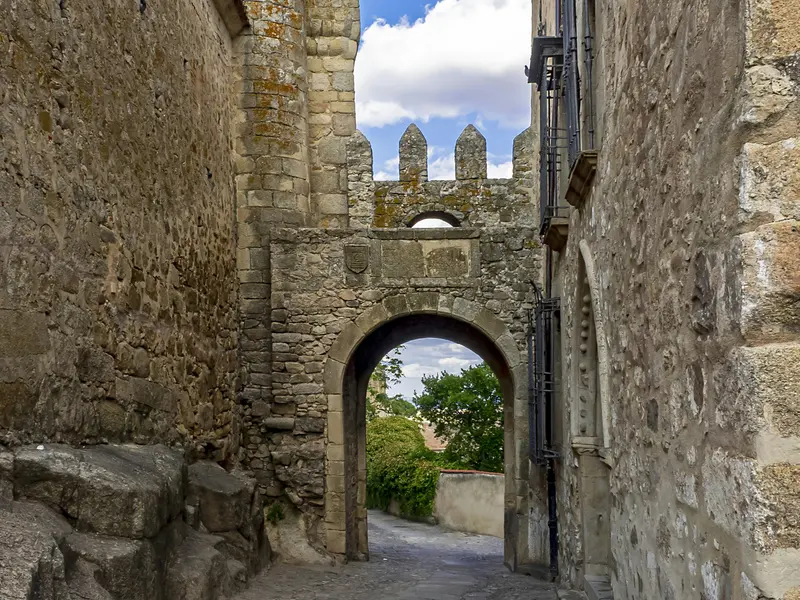
The Alberca in the upper town is another landmark connected with water. Locate it separately from the castle cisterns. If you have time for a different way down, look for Puerta de San Andrés as well as Puerta de Santiago. The surviving gateways give a sense of how paths entered the enclosed town from different sides of the hill.
On the way back to the main square, look at the approach to the gates. The turns in the streets can hide the opening until you are quite close. Where the pavement allows, look back from the outside to see how the road meets the wall. This makes for a different walk from the direct route up past Santa María, even though the two walks begin and end close together.
Around Plaza Mayor, compare the Palacio de San Carlos beside San Martín with the Palacio de la Conquista. Look for the carved shields and the way each building uses its corner. A few minutes observing each façade from across the square make it easier to pick out the details up close.
The Palacio de Juan Pizarro de Orellana offers a further comparison. Its frontage has two rectangular towers and a different approach to the doorway. From the public street, look at the placement of the family arms above the entrance. This is a useful stop when you want to see how the buildings away from the main square made a similar claim to prominence on a narrower route.
Museums and culture
The Casa Museo de Pizarro is a place to put the conquistador and the Spanish conquest of Peru into historical context. You can pair it with a look at the statue in Plaza Mayor and the coats of arms on the surrounding palaces. The displays and the objects placed in the public square tell the story in different ways. Check with the tourist office before planning a day around the museum.
The provincial guide describes a reconstruction of the home of a lesser nobleman on the lower floor, with material about Pizarro and the Inca Empire upstairs. Notice the change in scale from the domestic setting to the story of expeditions and conquest. Back in Plaza Mayor, the bronze statue by Charles Rumsey belongs to a much later period. The guide dates its installation to 1929.
For an art visit, spend time with the altarpiece in Santa María la Mayor. Choose a few panels to compare and notice how figures and scenes are arranged. Afterwards, look at how the makers of stone doorways directed attention to particular details. The holiday traditions of the town offer another perspective. The songs and dances of Chíviri link local memories with a public gathering in the central square.
Neighbourhoods and areas
The upper town lies between Puerta de Santiago, Santa María and the castle. Take the main route up and a neighbouring street on the way back if the slope suits. You can use the church towers or a gate to find your bearings when intervening buildings hide the castle.
Near Puerta de Santiago, look for the Alcázar de Luis de Chaves. Its position against the wall is a reminder of how a residence and the defence of an entrance could be connected. Give this stretch time before visiting the freestanding castle. When you return to Plaza Mayor, look up at the same slope from below and see which part of the line of walls you can still identify.
The lower town centres on Plaza Mayor. If you want to avoid the steepest streets, make a loop around the arcades and the church of San Martín, then explore towards San Miguel. From the square you can still look up to the castle and see how the upper and lower parts fit together.
Nature and protected areas
The plains around the town are a reason to bring binoculars. Pick public tracks with places to stop without blocking a gate or going onto private land. The first part of the day is useful in hot weather. For a first look without driving, survey the surrounding country from the upper town and decide which direction you want to explore. There are also birds to look for from the main square, using the roofs as a starting point.
Festivals and traditions
Chíviri took place on 5 April 2026, Easter Sunday. It centres on traditional music, dancing and dress in Plaza Mayor. The town council’s 2026 listings included events over the weekend. For future years, check the municipal programme and choose the part of the celebration you most want to see. Semana Santa processions and the Sunday festivities are different parts of the holiday. To see the square on a quieter morning, allow a day on either side of the celebrations.
Routes and itineraries
One day from Plaza Mayor to the castle
Begin at Plaza Mayor and San Martín, pass the Palacio de la Conquista and continue uphill through Puerta de Santiago. Pause at Santa María la Mayor before going on to the castle. Come down by the Alberca if you want another view of the old town. Choose a museum for the afternoon or spend more time around the square. In hot weather, reverse the order of the outdoor visits and reach the castle early.
A second day in the countryside
After a day in town, look for birds on the plains or give Monfragüe a day of its own. Keep the evening free to walk around Plaza Mayor again. If you want more time to see the upper town, split the trip into a castle morning and a separate visit to the church and palaces.
Day trips
Cáceres and Guadalupe
In Cáceres, walk through Arco de la Estrella to see how the historic squares sit within the walls. Plan to see the Helga de Alvear Museum if you want to combine architecture and art. Further east, Guadalupe draws visitors to its Royal Monastery and the streets of the Puebla. For both the monastery and a geopark walk, consider staying in Guadalupe for a night.
Monfragüe
At Salto del Gitano, look towards the cliffs over the Tagus. Villarreal de San Carlos is another point of reference inside the national park. Pick a small number of viewpoints and leave time to look from each. A park day works best when you give it the hours you would otherwise spend walking round Trujillo.
The park outing and the plains offer different views. At the river, look along the cliffs and the spaces over the water. On the plains, you can look across a larger area from a single stopping point. Choose according to the terrain you want to see and how far you want to travel. Bring binoculars if you want to spend longer at one spot.
Travelling with children
Start in the square and look for the castle above the houses. On the way uphill, try to spot it again when the streets open up. Use Puerta de Santiago to decide whether to go further. There is plenty to see around the square if the climb is too hot or the group is ready for a break.
Where to stay in Trujillo
Near Plaza Mayor. Stay close to the square for evenings on foot and to divide the walk to the castle into shorter outings. Check where you can leave your car if dates coincide with a festival.
In the upper town. Choose this area for early walks near Santa María and the castle. Ask about the approach with luggage and look at the walk home after dinner.
On the edge of town or in the countryside. A good fit for an early start towards the plains or Monfragüe. Check the road you need for trips out and the route back to the main square.
See places to stay in Trujillo (opens in a new tab)Affiliate link: if you book through it, we may earn a commission at no extra cost to you.