

 Español
 English

Why visit Toledo
Start a first visit to Toledo in Plaza de Zocodover and walk towards the cathedral and the Jewish Quarter. On a map it is a short journey. On foot it means changing levels, turning from narrow lanes into small squares and looking up to find buildings whose towers are visible from miles away. The old town grew on high ground embraced on three sides by the Tagus. Go down to the river or cross it and look back to see the shape of the historic city that UNESCO added to the World Heritage List in 1986.
Toledo is the capital of Toledo province and of Castilla-La Mancha. You can come for the day from Madrid, but staying gives you time for the river as well as the churches and museums. For a visit built around architecture, put the former mosque and the two surviving synagogues on the same list as the cathedral. For a visit built around painting, see El Greco’s work in two settings, a church for which he painted a commission and a museum where you can take time over several canvases.
When to go
Spring and autumn suit a trip split between streets and river paths. In early spring the lower banks can feel cool even when the sun is out on the hill. In autumn, set a return time before walking to Mirador del Valle in the late afternoon. The light moves across the city before the streets themselves disappear into shadow, and it is tempting to stay longer than planned.
Summer is easier if you walk to the river or climb in from the station early, then give the middle of the day to the cathedral or a museum. Some lanes do offer shade, but the bridges, lookout points and Zocodover are more exposed. Winter gives you a shorter window for longer walks. Use the brighter part of the day for the views and plan time indoors on either side. After rain, slow down on cobbles and on the steps below the old gateways.
Getting there and around
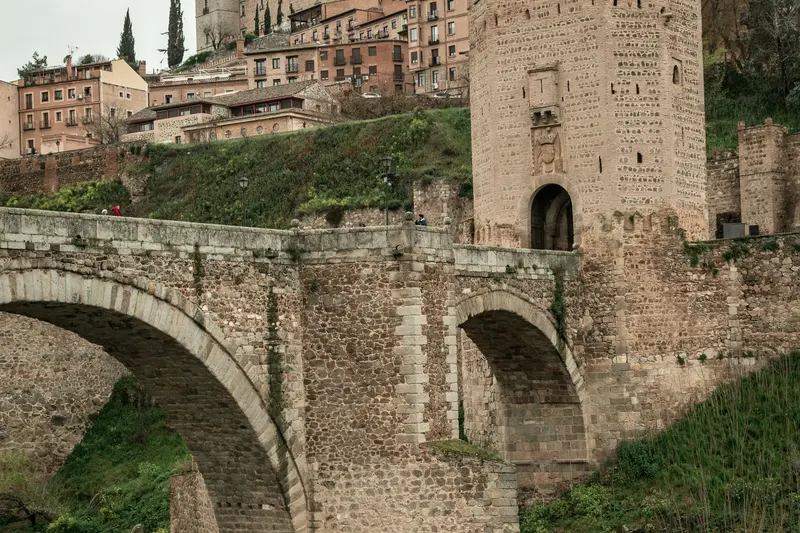
From Madrid Atocha to Toledo on foot
In 2026, Renfe described the journey from Madrid-Puerta de Atocha-Almudena Grandes as taking a little over half an hour. If you are arriving at Barajas first, allow time to get to the departure station shown on your ticket. At Toledo station, take a moment to look at the Neo-Mudéjar building before heading towards Alcántara bridge. The Alcázar above it gives you a sense of the climb ahead. This approach is worth doing on foot if you are travelling light and want to see how the city rises above the Tagus.
Toledo’s municipal visitor information for 2026 lists city bus and taxi options from the station. With luggage, or if you would rather save your energy for the centre, either is worth considering. If you have hired a car for onward travel through Spain, check whether your accommodation is inside the walls and how you can get to it. The historic centre is compact enough to walk and has lanes where driving and dropping off are less straightforward than the map suggests.
Making the hills work for your route
Zocodover is a good landmark in the upper town. The cathedral stands by the town hall, and the Jewish Quarter lies farther west. If you need to get back to the station, finish on the eastern side near Alcántara. If you have time for a riverside walk, finishing at San Martín on the opposite side of the old town gives you a natural descent. Take the height differences into account if somebody in your group tires easily. A short connection between two points can involve a steep lane or steps.
What to see in Toledo

Zocodover and the Alcázar
Zocodover brings together several of the routes into the old town. Pass under the Arco de la Sangre for a look down the eastern slope, then head back into the square for the short climb to the Alcázar. The fortress anchors the view for anyone coming in by train. If you plan to visit the Army Museum inside, give it its own place in the day. The displays and the archaeological remains incorporated into the building can take much longer than a look around the exterior. On a shorter visit, continue from the square in the direction of the cathedral.
The cathedral and Santo Tomé
Start outside in Plaza del Ayuntamiento, where a small square has to accommodate views of the cathedral, the town hall and the archbishop’s palace. Inside, pick out the choir stalls for close carving and the Transparente for the way daylight is directed into the sculpture. Allow time for the sacristy if you are interested in El Greco. Seeing his paintings in the church that commissioned work from him makes the next stop, Santo Tomé, a useful comparison. There you can see a whole composition intended for a particular site rather than several works together.
The city from the far bank
From Mirador del Valle the cathedral spire and the square mass of the Alcázar are easy to pick out. Then look lower, at the drop from the roofs to the river and the buildings at the edge of the rock. From either bridge, what stands out is the steepness and the height of the walls. From the far bank you can see how the whole hill fits together. Part of the route follows the road. Plan the return as part of the outing and leave daylight for the sections where you will be walking beside traffic.
Monuments and heritage
Gates and an old mosque
The Puerta de Bisagra is the ceremonial-looking gateway with round towers and a great shield facing outwards. The older Puerta Vieja de Bisagra, also known as the gate of Alfonso VI, is nearby but built on a different scale. Compare them in a short walk along the northern edge before climbing towards Cristo de la Luz. The building began life as the small mosque of Bab al-Mardum. Look up from each part of the prayer space to see how the little vaults differ, then notice the apse added after its conversion to Christian use.
Synagogues and a monastery
At Santa María la Blanca, the rhythm comes from rows of white pillars and horseshoe arches. In El Tránsito the chief impression is of one large hall, with a decorative frieze and relief work high on the walls. The two spaces also show how building techniques and ideas crossed between medieval communities. Save time for the cloister of San Juan de los Reyes if you want to see another way of organising a late medieval interior. The galleries lead round a courtyard, and the stone carving rewards close attention. All three buildings are close enough to combine. Two visits are often a better fit for a short afternoon.
Museums and culture
Finding El Greco across the city
The famous painting at Santo Tomé is usually called The Burial of the Count of Orgaz in English, though Orgaz was a lord. Look at the lower figures first, then follow the scene upwards to see how differently the artist treats the two registers. The Museo del Greco near Paseo del Tránsito gives you a chance to see the apostles and the View and Plan of Toledo. Look for shapes that seem familiar from your walks around the city. The museum also presents a reconstructed period setting, useful for thinking about the domestic world around the artist’s commissions.
The Sephardic Museum and Santa Cruz
At the Sephardic Museum, begin with the former El Tránsito synagogue itself. The objects on display then put Jewish communities in Spain and the wider Sephardic world into context. The Museo de Santa Cruz is in a former hospital near Zocodover. Its façade and courtyards help explain how prestigious public buildings were laid out, even if your main reason to go inside is the art. It works well on a separate day from the Jewish Quarter if both collections are priorities. Grouping visits by area keeps you from making the same climb more than once.
Neighbourhoods and areas
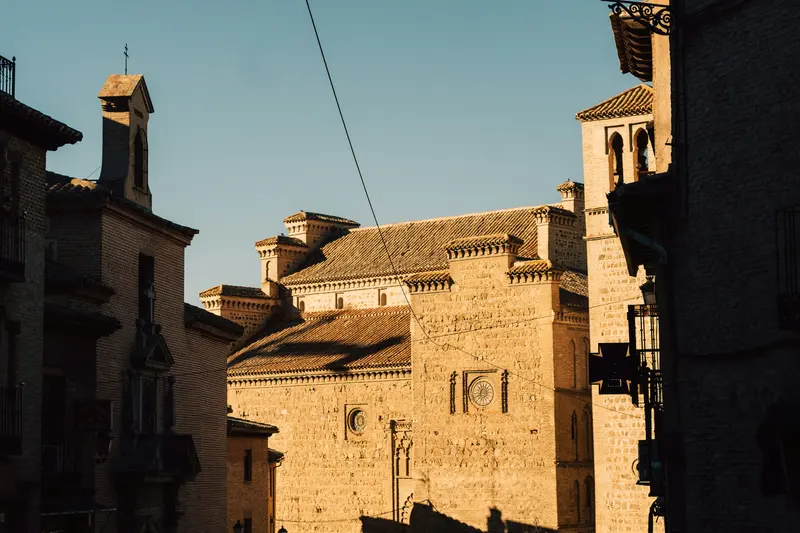
Walk through the Jewish Quarter at a pace that lets you notice changes of view between streets and courtyards. Calle de Santo Tomé leads towards Paseo del Tránsito and San Juan de los Reyes. Follow the western slope down to San Martín bridge and you end up well below the buildings you have just visited. This is a good moment to decide between a riverside stretch and a climb back into town.
Up top, Zocodover and the lanes leading to the cathedral make a practical first area to explore. Outside the north wall, the Vega and the surroundings of Bisagra are more open. Santa Bárbara, over to the east, is useful as a point of arrival by train. On the other side of the river, the Valle road and the estates known as cigarrales are places to see how the city sits in the landscape. They are best treated as a separate leg of a visit.
Nature and protected areas
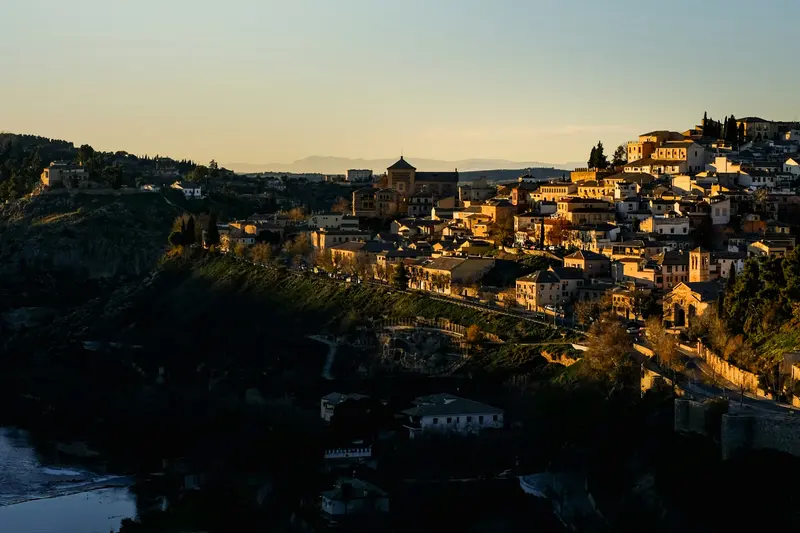
The Senda Ecológica follows the Tagus beneath the old town. Down there, the interest is in the water, the rock, the old bridges and the traces of buildings that once depended on the river. Near the former tanneries and Baño de la Cava, it is easy to see why trades that needed water and working space were carried on outside the upper streets. You can take on one short stretch before climbing back to town or set aside a longer walk just for the river.
Across the river, the area around the chapel of Nuestra Señora del Valle gives a changing view with relatively little walking. Look east for Cerro del Bú. Towards evening the lit rock and the shadow between buildings help separate one part of the town from another. Give this outing time of its own if you enjoy looking at the landscape. There is little to be gained from racing between all the lookout points on both sides of the Tagus.
Festivals and traditions
Corpus Christi changes the appearance of the old town more than any other event. In 2026 the holiday fell on Thursday 4 June. The procession takes the cathedral’s monstrance into streets prepared with awnings, decorations and aromatic plants. If you come for the occasion, choose a stretch of the route ahead of time and approach via side streets. Visitors who mainly want to see the buildings can organise those visits around a different part of their stay and give the procession a morning of its own.
The feast of Toledo’s patron saint, Ildefonso, was a local holiday on 23 January in 2026. The municipal calendar also marked 26 November as a holiday for the fortieth anniversary of UNESCO listing. Check the municipal programme for the year of your trip. Corpus Christi moves around the calendar and the anniversary holiday was specific to 2026.
Sport and outdoor activities
For a more active outing, join a section of the Senda Ecológica with a walk over one of the bridges. The climb back is usually a better measure of the effort than the time along the water. If you want to run, the clearer parts of the riverside make more sense than the steps and cobbles in town. The Valle side offers longer views and stretches beside the road. Decide how far to go based on the pedestrian space and how much daylight you have left.
Routes and itineraries
A day in the old town
If you arrive by train, enter across Alcántara and climb towards Zocodover. Continue to the cathedral, then head to Santo Tomé and the former synagogue of El Tránsito. From Paseo del Tránsito, you can choose whether to carry on to San Juan de los Reyes or finish the interior visits there. Spend the end of the day at San Martín bridge or across the Tagus at the Valle viewpoint. Leave time for the return to the station, especially from the western side of town.
Two days with time for the Tagus
On day one, pair the cathedral with Santo Tomé and the Greco museum. Start the second day near Bisagra, follow the uphill road to Cristo de la Luz and cross towards Santa María la Blanca and San Juan de los Reyes. After the cloister, follow the slope down to the river. If you care more about the city panorama, cross the Tagus and spend the afternoon at Mirador del Valle. From the lookout you can pick out the towers and bridges you passed over the two days.
A half-day stop
Choose one interior and build the walking around it. For the cathedral, include Zocodover, the town hall square and the descent towards Alcántara. For El Greco, pair Santo Tomé with the lane down to Paseo del Tránsito and a look out from the gardens. This gives you a visit you can finish with a little time to spare. Check the point from which you need to leave before committing to a long descent or an additional ticketed stop.
Day trips
The Barrancas de Burujón
The clay cliffs beside the Castrejón reservoir offer a different view of the Tagus from the one around Toledo. The route described by regional tourism starts near the CM-4000 road. Give most of your time to the marked viewpoints, where the effects of erosion on the clay are clear. The outing makes sense in dry weather with good visibility. Check the ground after rain before committing to the longer stretches.
Consuegra and the La Mancha plain
At Consuegra the windmills and castle of Cerro Calderico overlook a wide plain. It is a good follow-up to the enclosed streets of Toledo. You could add Tembleque to see the timber galleries around its main square, where the interest is in how a village uses a public space rather than a view from high ground. With a car you can fit both places into a day. If you want to see inside the castle and a mill, treat the second village as optional.
Talavera de la Reina
Head west to Talavera de la Reina to follow a different strand of the province’s history. The Ruiz de Luna Museum shows ceramics grouped together, and the Basilica del Prado lets you see tiles in the place for which they were made. Finish by the Tagus if you have time after walking along the walls. Give the town a full day if you want to cover the museum, the old quarter and the river on the same visit.
Travelling with children
Make a short walk into a hunt for gates and towers between Bisagra, Zocodover and the cathedral. Children who can identify a few buildings can look for them again from the other side of the river. With a pushchair, plan to enter and leave through the same part of the old town if that reduces climbing. Alcántara bridge is a worthwhile stop in itself. Count the arches, find the Alcázar on the hill and look down at the water before deciding how much farther the group wants to walk.
Where to stay in Toledo
Near Zocodover it is easy to divide a visit into short spells. The cathedral area works if you want an early start and a room you can return to between visits. For accommodation in the Jewish Quarter, compare the route from the station or car park with the walks you will make each day. Two places that look equally convenient on a map can differ considerably in gradient.
If your plan includes several drives into the province, look around Bisagra or towards the station for an easier exit. Across the river, the cigarrales suit a stay built around the landscape when you have planned how you will get in and out of town. Decide whether walking out in the evening or getting away quickly by car in the morning matters more to your trip.
See places to stay in Toledo (opens in a new tab)Affiliate link: if you book through it, we may earn a commission at no extra cost to you.