

 Español
 English

Why visit
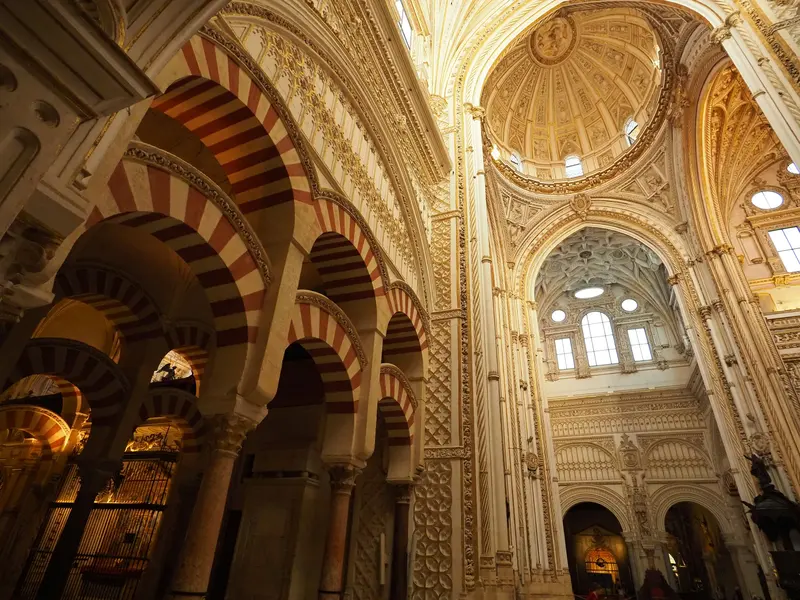
The Mosque of Córdoba stands in the old town of Córdoba, a short walk from the Guadalquivir. Inside, rows of columns carry two tiers of arches in red brick and pale stone. Walk towards the cathedral crossing and the ceiling rises to the height of the church vaults. From a single aisle you can take in the structure of the former prayer hall and the much later work built into it. This is the building often called the Mezquita or the Great Mosque of Córdoba.
Allow an hour to 90 minutes for the courtyard and interior. A good way to get your bearings is to pick out three places on the plan: the orange tree courtyard on the north side, the mihrab on the south wall and the cathedral crossing within the former prayer hall. Once you have those landmarks, take your time looking down the aisles or making a detour to a chapel. Give the bell tower a separate block of time if you want to climb it.
From the lanes around the site it can be hard to see how much space the monument takes up. Walk down to the Roman Bridge after the visit and cross towards the Calahorra Tower. Look back from the far bank, where the crossing and bell tower rise above the long, low outline of the mosque. That view puts the spaces you have just walked through in the context of the old town and river.
A short history
Abd al-Rahman I, the first independent Umayyad emir of al-Andalus, began building the congregational mosque in the eighth century. Columns and capitals from earlier buildings went into the first prayer hall. Look at the shafts and their tops as you walk through the oldest section. Some change colour or shape from one row to the next, even though the pattern of arches above them is consistent.
Abd al-Rahman II extended the prayer hall in the ninth century. In the tenth, Abd al-Rahman III worked on the courtyard and built a minaret. His successor, Al-Hakam II, extended the hall south and built the mihrab and the maqsura, the area reserved for the ruler by the prayer wall. Almanzor made a further extension eastwards towards the end of the tenth century. The floor plan makes it easier to see how adding aisles along one side left the mihrab off-centre in the enlarged building.
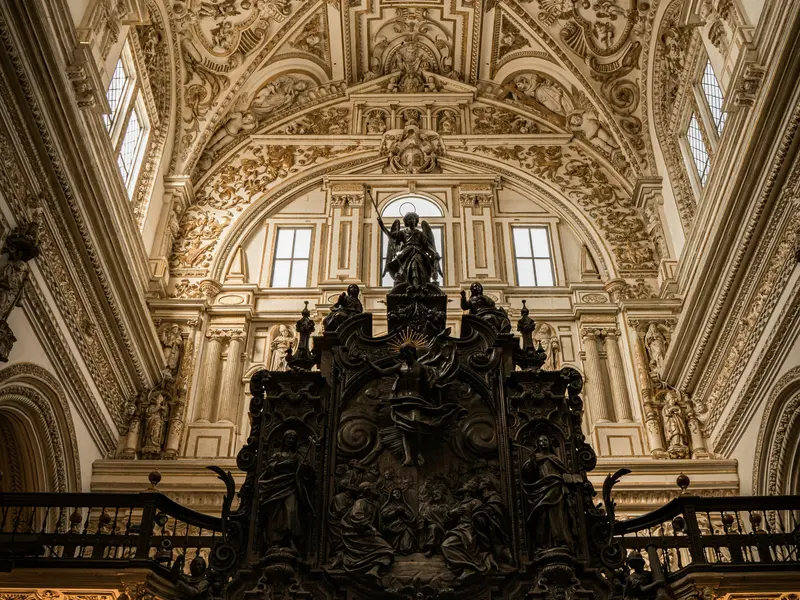
The building was consecrated for Catholic worship after Ferdinand III took Córdoba in 1236. The Villaviciosa Chapel served as the first main chapel, and work on the cathedral crossing began in 1523. The bell tower was built around the earlier minaret and the courtyard was laid out as a garden in the late sixteenth century. UNESCO listed the mosque in 1984 and extended the World Heritage property to part of the historic centre in 1994, taking in the Roman Bridge and Calahorra Tower.
What to see inside
Courtyard and arches of the Mosque of Córdoba
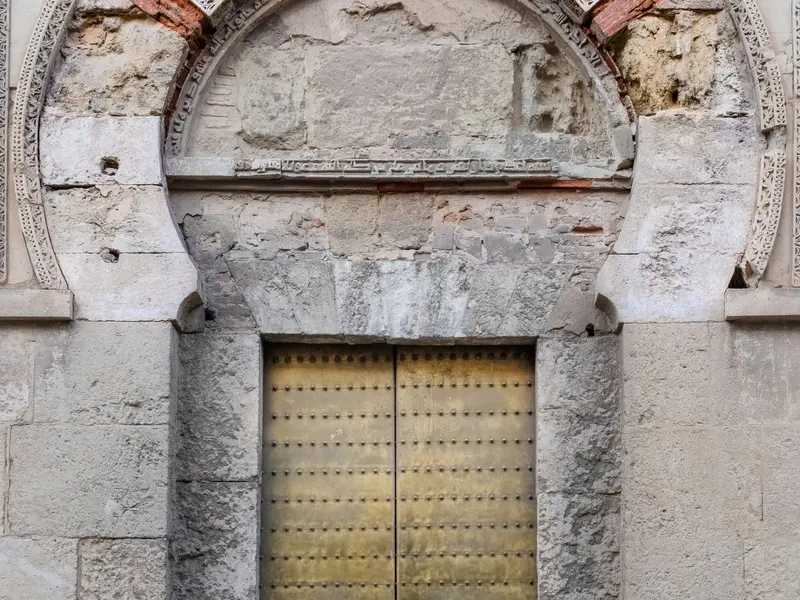
Start in the Patio de los Naranjos, the courtyard planted with orange trees. Look along the row of doors facing the courtyard before you go inside. The paths between the trees give you a sense of the building’s width. The Puerta del Perdón is the gateway beneath the bell tower on Calle Cardenal Herrero, a handy landmark when you are working out which side of the complex you came in from.
Inside, follow a single aisle with your eyes. The lower arches have a horseshoe shape and the upper ones carry the roof. Using two tiers gave the builders more height above the columns. Move to a cross aisle and look diagonally through the hall. Different rows will open up as you move, and the pattern extends much farther than it might have seemed from the doorway. Look closely at a few of the arches to see how brick and stone alternate.
Mihrab, maqsura and Villaviciosa Chapel
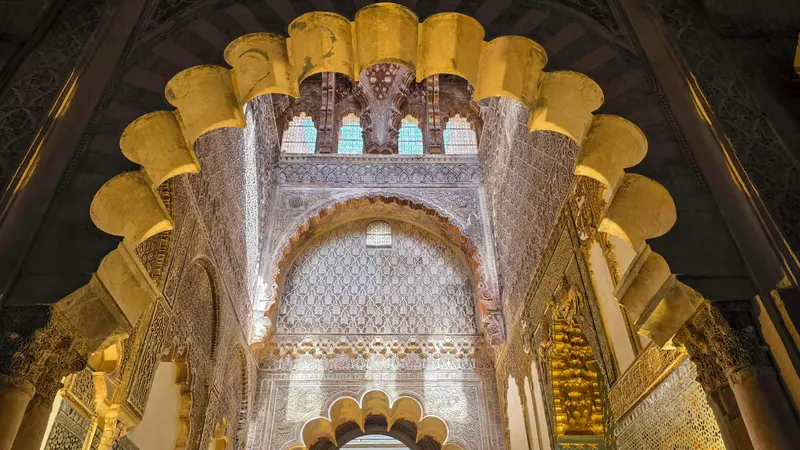
The mihrab marks the direction of prayer in the former mosque. Here it is a small chamber set into the south wall, framed by a horseshoe arch with bands of inscriptions and plant motifs. Go as close as the visitor route allows. Then find a position a little farther back to see how the doorway fits into the wider wall and how the layered arches frame the space around it.
Look up to see the ribs crossing the caliphal vaults. Use the plan to find the Villaviciosa Chapel near the start of Al-Hakam II’s extension. Its use as the first main chapel gives you a point of reference for the Christian building before the later crossing was built. If several groups arrive at once, take in the mihrab and return to the chapel area once you can stand back far enough to see the arches.
Cathedral crossing, main chapel and choir
In the crossing, look up from the base of a pier towards the high windows. Turn back towards the mosque aisles to compare where light enters the two structures. The altar gives the main chapel a clear focus. Across the crossing, the carved wood of the choir stalls rewards a closer look from the visitor route. Walk around the sides to see where the cathedral interrupts the grid of columns and where the aisles continue past it.
Tickets and opening hours
Checked in November 2026. The Cathedral Chapter’s daytime tariff listed a €15 standard ticket. It charged €12 for visitors over 65, students aged 15 to 26 and youth card holders. The ordinary rate for children aged 10 to 14 was €8, and children under 10 entered free. Other concessions were available. Choose the categories in the official ticket shop and bring the documents it asks for.
Use the official calendar to check the day you intend to go. For example, the published daytime hours on Saturday 28 November 2026 were 10:00 to 18:00. Last entry was half an hour before closing. This is a working Catholic cathedral and services or other events can change the hours available for sightseeing. Check Sunday and holiday plans before you book a train or build a tight itinerary.
In 2026 there was a free individual visit from 8:30 to 9:30, Monday to Saturday, except on days with special celebrations. Entry stopped at 9:20 and visitors then began to leave. If you want longer with the architecture or an audio guide, allow for how little time is left towards the end of that window. In November 2026, tickets and audio guides were available at the San Eulogio visitor centre. You could start there for an introduction before entering the monument.
The bell tower and The Soul of Córdoba night visit had separate tickets. In November 2026 the standard prices were €4 for the tower and €25 for the night visit. The tower used timed entry and stairs, with age and mobility restrictions set out in the visitor rules. The evening programme uses light and sound on a set route. For help identifying the different phases during the day, consider a guided visit to the Mosque-Cathedral. Check whether admission is included and where you need to meet the guide.
In November 2026, the Cathedral Chapter’s rules asked visitors to dress appropriately for a place of worship and prohibited tripods and large bags. If you are coming straight from the station or have to check out before your visit, arrange somewhere to leave your luggage before heading to the monument.
Getting there
On foot. The official address is Calle Cardenal Herrero, 1. From Plaza de las Tendillas, head south via Calle Jesús María and the area around Calle Ángel de Saavedra towards the Jewish Quarter. If you are staying south of the river, cross the Roman Bridge and walk uphill past the Puerta del Puente. When arranging to meet someone, give them a street or gate name. The courtyard, the tower and the visitor centre are separate landmarks.
By train, bus or taxi. Allow around 25 to 30 minutes on foot from Córdoba station, especially if you are finding your way through the old town for the first time. In November 2026, the Cathedral Chapter listed Puerta del Puente as the stop for city bus routes 3 and 12, and Calle Torrijos, 6, as the taxi rank for the site. Check the route from your starting point. If you are driving around Andalusia, choose parking before heading into the narrow streets around the monument.
With reduced mobility. In November 2026, the visitor rules directed visitors to Deanes Gate for accessible entry to the courtyard. The Cathedral Chapter’s map shows the route inside, adapted toilets and the wheelchair loan point. Check the map before choosing where to get out of a taxi. If some of your group will climb the bell tower, the courtyard makes a convenient place to meet and continue to the river together.
Best time to visit
Spring and autumn are good seasons to combine the sightseeing visit with a long walk outside. In summer, cross the Roman Bridge early or towards evening if you can. There is little shade on the bridge. A morning visit to the monument leaves time to stop for lunch before deciding how far to go along the river later on. For a short trip, set the monument time first and put the riverside walk wherever it fits.
An early start is easier when you have already spent the night in Córdoba. If you are visiting on a day trip by train, allow some time between arriving at the station and the start of any timed booking. In winter, leave enough daylight for the view of the old town from the far bank. In wet weather you can spend more time on the interior and shorten the walk. If you have a tower booking, check whether the climb is going ahead before setting off.
What else to see nearby
For a short walk from the Mosque-Cathedral, head down past the Puerta del Puente and cross to the Calahorra Tower. Walk a little way along the riverbank to see the bridge and the building from the side before returning. You can then follow the river to Plaza del Potro or go west towards the Alcázar de los Reyes Cristianos and the San Basilio neighbourhood. Both walks start nearby, so you can decide which way to turn when you leave the monument.
For another piece of medieval architecture, take Calle Deanes into the Jewish Quarter and look for Córdoba Synagogue on Calle Judíos. A small courtyard and vestibule lead from the street to the prayer room. Look for the Mudéjar plasterwork before walking on to the Puerta de Almodóvar, a useful landmark at the edge of the quarter.
If you have a second day, visit Medina Azahara, the caliphal palace city west of Córdoba. The remains and museum give you a view of how power was organised during the period that produced the mosque’s most elaborate expansion. The Córdoba province guide covers more places to visit beyond the capital. For a trip that takes in Granada or Seville as well, compare the itineraries in the Andalusia guide.
Where to stay
The Jewish Quarter and Calle Torrijos put you within walking distance of the monument for an early visit. If your accommodation is on a lane inside the old town, ask where a taxi can drop you off or where to park. A short distance on the map can involve cobbles or passages that are awkward with luggage. Check the walk to the train station too if you have an early departure the following morning.
Between the Tendillas and the Paseo de la Victoria you are still close to the old town and can choose a more direct approach from the station. The Ribera is convenient if you are planning walks along the Guadalquivir or want to cross the bridge again in the evening. For a two-night stay you can keep the same base, visit the mosque on the first morning and spend the other day on Medina Azahara.
See accommodation in Córdoba (opens in a new tab)Affiliate link: if you book through it, we may earn a commission at no extra cost to you.