

 Español
 English

Why visit
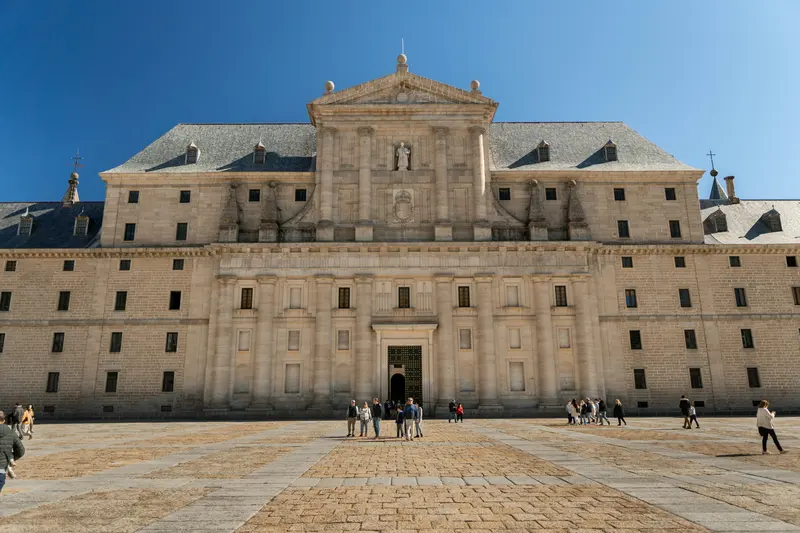
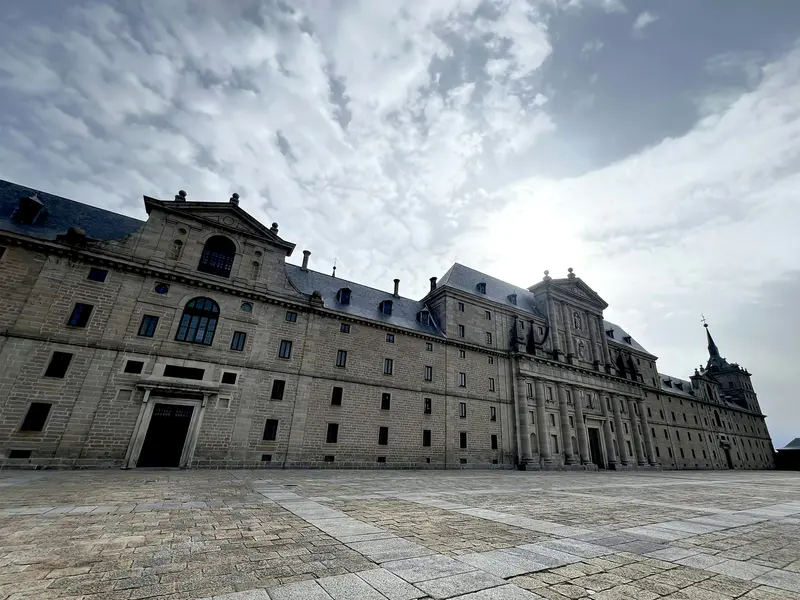
The Monastery of El Escorial stands on a slope below Mount Abantos in San Lorenzo de El Escorial. Approach across the Lonja, the paved terrace along two sides of the building, and the rows of windows and slate roofs give you a sense of its size. Inside, a courtyard frames the basilica, the library draws your eye to a painted ceiling, and the royal pantheon takes you into a small marble chamber below the high altar.
You can visit in a day from Madrid. Keep half a day for the monument if you want to see both museums and spend time with the paintings. On a shorter visit, make the library, basilica and rooms of Philip II your priorities. If the landscape is what drew you here, walk around to the garden side and save the woods for after lunch. The centre of town is close enough for a break between the two.
Of the historic sites in the Community of Madrid, El Escorial shows particularly clearly how Philip II arranged court life around religious observance. Notice when the building makes you look up and when it makes you stop. The height of the basilica is apparent as soon as you enter. The meaning of the library’s painted vault comes into focus when you can pick out individual figures and objects.
A short history
How the Monastery of El Escorial took shape
Philip II founded a monastery for the Hieronymite order and combined it with a royal residence, a place of study and a burial site for the dynasty. He commissioned Juan Bautista de Toledo to design the complex. The first stone was laid in 1563 and Juan de Herrera took on a leading role after the first architect’s death. The last stone was laid in 1584. Work on the basilica and the decoration continued, which helps explain why a single construction date tells only part of the story.
The foundation was intended to commemorate the king’s parents, Emperor Charles V and Isabella of Portugal. The axis from the west front to the church makes the importance of the basilica clear on the ground. On either side of the high altar stand bronze groups showing the families of Charles V and Philip II. The royal living quarters cluster around the far end of the church. Their position gives a direct sense of how the court was intended to live.
The Habsburgs and the town that grew around the court
The royal pantheon took its final form under Philip IV. The Bourbons later adapted parts of the palace for their own use. Under Charles III, Juan de Villanueva designed buildings for a court that spent part of the year in San Lorenzo. The small villas and royal theatre tell that later story outside the monastery walls. UNESCO inscribed the Monastery and Site of the Escurial in 1984. Its map shows how the gardens and other buildings fit into the estate around the monastery.
What to see inside
The Kings’ Courtyard, basilica and royal pantheon
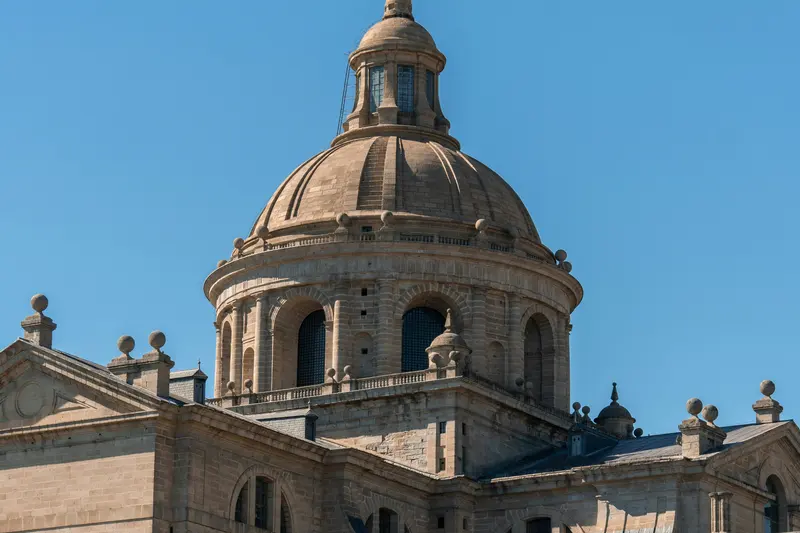
In the Kings’ Courtyard, look for the statues of biblical kings above the entrance to the church. The façade in front of you belongs to the basilica inside the vast rectangular block of the monastery. On entering the church, look up to the dome to get your bearings. Once you have found the high altarpiece, compare the two funerary groups in gilded bronze by Pompeo Leoni. Look for the kneeling figures on each side in turn.
The Royal Pantheon is a chamber beneath the high altar. The bronze figures you have just seen belong upstairs and the royal tombs occupy the marble chamber below. The stairs and the change from a tall, open space to an enclosed room give this part of the visit its character. If anyone in your group needs to avoid stairs, ask the monument in advance which parts of the route they can use.
The library and the Hall of Battles
In the library, start with Pellegrino Tibaldi’s frescoed vault and then look at Juan de Herrera’s bookshelves. The paintings give human form to the liberal arts, while the instruments and globes show how scholars represented and measured the world. Look for the gilt edges of the printed books turned towards the room. You may miss the gold line along the shelves if you spend the whole time looking at the ceiling. The maps and instruments are a reminder that this was a place of study.
In the Hall of Battles, pick one painting and follow how it is put together. The mural of the Battle of La Higueruela shows how the painters made formations of soldiers readable across a room. Other scenes show campaigns from Philip II’s lifetime, including Saint-Quentin. The sequence was part of the palace setting through which people made their way to see the king. After the painted ceiling in the library, the long walls give you a different way to follow the story in the room.
The Painting and Architecture Museums
The two museums reopened in October 2026, as set out in Patrimonio Nacional’s reopening notice. The Architecture Museum explains the design and building work, which can be easier to follow after seeing the courtyards. The Painting Museum traces the development of the royal collections and includes work by artists such as Titian, Tintoretto and Ribera. Pick Architecture if you want to make sense of the plan. Choose Painting if you are curious about what successive monarchs collected.
Tickets and opening hours
Prices and choosing a ticket
In November 2026 a standard ticket cost €14 and the reduced rate was €7. The reduced price applied to groups including visitors aged 5 to 16, people over 65 and students up to age 25 with valid student ID. Official guided tours added €8 to the relevant admission price. Find both Spanish and English tour times on Patrimonio Nacional’s official ticket page. The English-language tour was listed at 10:45 from Tuesday to Sunday in 2026, so check availability before choosing your transport.
In 2026 free entry on Wednesday and Sunday afternoons started at 15:00. The offer covered EU nationals, people with qualifying EU residence or work permits, and nationals of Ibero-American countries, with supporting documents. The official ticket page directed visitors booking only free tickets to the box office. There was a separate free ticket at the box office for the Painting and Architecture Museums until 31 December 2026, on opening days. Both museums were included with standard admission. Patrimonio Nacional announced that from 2027 they would stay on the main ticket and a museum-only ticket would also be available.
Opening times and entrances
The standard 2026 schedule was Tuesday to Sunday. From October to March the monument opened 10:00 to 18:00, with last admission at 16:45. From April to September it opened 10:00 to 19:00, with last admission at 17:45. Monday was the regular closing day. Check the notices for your date, as official events or Christmas closures can change the opening hours and last entry.
In November 2026 independent visitors used the west front, through the Kings’ Courtyard. Guided tours, groups and visitors with museum-only tickets used the north entrance. The ticket office was across from the north front at the Visitor Centre, Avenida de Don Juan de Borbón y Battenberg 4. If buying online, find the named entrance before crossing the forecourt. The 2026 ticket information gave separate access to the basilica without a ticket, with visits interrupted during religious services.
In 2026 the published visitor information described accessibility as very limited. If steps are an issue, check with the monument about the specific rooms and entrance before paying. Personal photography without flash was permitted where signs allowed it. Tripods and selfie sticks were prohibited, and visitors were advised to avoid backpacks. The official visitor guidance is also the place to check for changes affecting a particular room.
Getting there
In 2026 regional buses 661 and 664 ran from Madrid’s Moncloa interchange. The 661 travelled via Galapagar and the 664 via Guadarrama. Both went to San Lorenzo, so they are a straightforward choice for spending the day around the monastery and town centre. Check your outward stop and return time with the Madrid transport authority. In Moncloa, allow time to find the interurban buses after you leave the Metro.
El Escorial station is in the neighbouring town downhill. The monastery’s ticket site listed the commuter rail service as C-8 in 2026. Use the station name when checking the Cercanías Madrid planner for the day you travel. The local transport authority also listed buses 1 and 2 between the two towns in 2026. If you walk up from the station, leave a gap between the train arrival and your timed admission. The downhill walk can be an easier choice at the end of the day.
For drivers coming from Madrid, the official directions in 2026 gave two routes off the A-6 corridor, one via the M-505 and a later turn towards the M-600. Use the full name of San Lorenzo in your navigation app. If you need to collect tickets, save the Visitor Centre as well. Leave time to walk from wherever you park, especially if your group is meeting at one of the two entrances.
Best time to visit
A weekday morning lets you start with the building and decide later how much walking you want to add. If you want to use a free afternoon slot, work out what you most want to see and how much time will remain once you have collected the ticket and cleared the entrance. In winter an early visit leaves daylight for the town. In summer you can cross the open forecourt before the midday sun and make your longer break after seeing the interior.
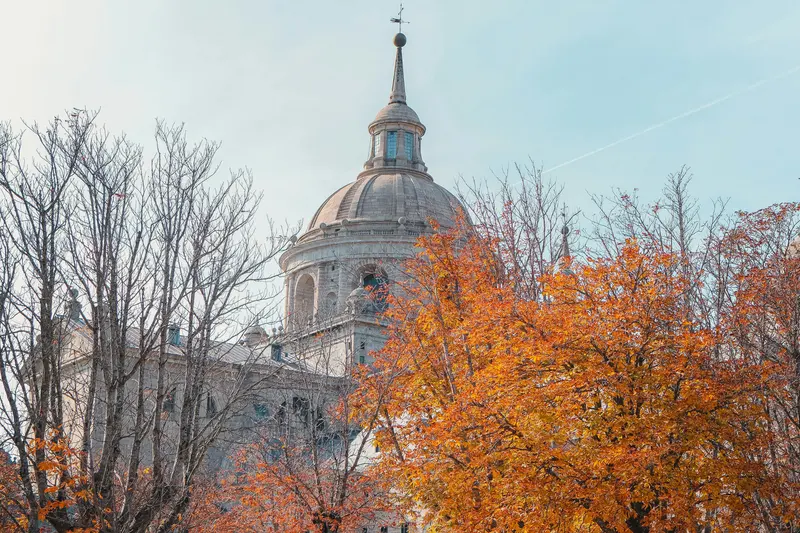
Spring and autumn are good times to combine a visit with a walk through La Herrería. From the terrace, look towards the hillside to see how the light changes across the stonework and woods. On a wet or windy day, stay close to the town and use the extra time for the museums. Wear shoes that grip on granite paving and bring a layer for the exposed forecourt. For children, a detail to find in one large room and a break outside can make the long interior route easier to enjoy.
What else to see nearby
The gardens, royal villas and old town
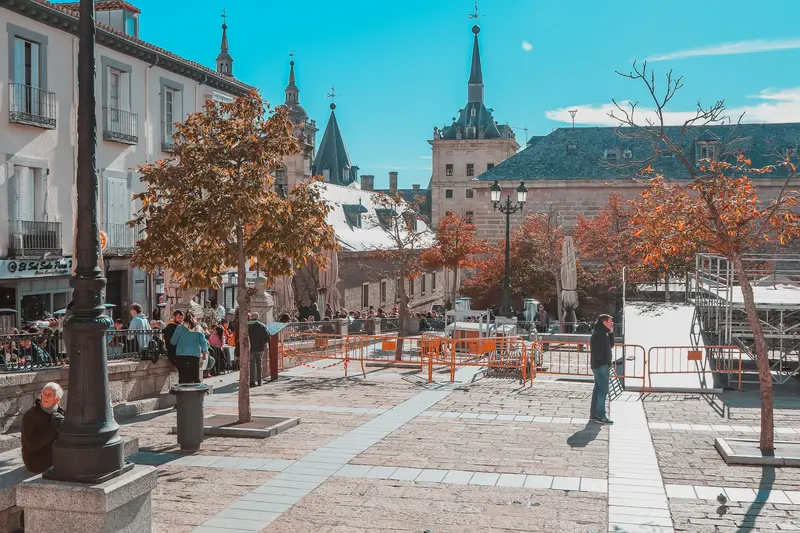
From the Monks’ Garden you can look back at the southern front across low hedges and terraces. It is a useful second view after the sweep of the Lonja. Patrimonio Nacional published separate garden hours in 2026. For a short town walk, also make time for Calle Floridablanca and the Royal Theatre of Charles III, a court theatre that opened in 1771.
Villanueva’s two villas lie in different directions. The Casita del Príncipe is on the station side, in El Escorial. The Casita del Infante is in San Lorenzo towards La Herrería. In 2026 their interiors opened for guided visits only and each had its own schedule, so check the official listing for the one you choose. If you prefer to stay in town after lunch, look at the Royal Theatre programme and leave time for a performance if it suits the rest of your plans.
La Herrería and Philip II’s Seat
Take Paseo de Carlos III towards La Herrería for an open view of the site. The town’s route to the Silla de Felipe II leads through the woods to the granite viewpoint known as Philip II’s Seat. From there you can see the outline of the monastery in relation to the town and hillside. It is a good follow-up to a walk around the forecourt. If daylight is short, make a smaller circuit at La Herrería and save the viewpoint for another day.
Where to stay
Stay in central San Lorenzo if you want to reach the Kings’ Courtyard on foot and carry on towards Floridablanca or La Herrería. Check the gradient of the last part of the walk from the bus stop if you have luggage. With two mornings, you can give one to the monastery and another to the woods, with time for a meal or a visit to the theatre in between.
Accommodation near El Escorial station makes sense if you are continuing by rail the following day. Factor in the uphill journey or local bus if you want to return to the monastery. If several days of your trip are centred on Madrid, you can stay there and reserve a whole day for San Lorenzo. Check the last convenient return before you book a second timed visit or an evening performance.
See places to stay in San Lorenzo de El Escorial (opens in a new tab)Affiliate link: if you book through it, we may earn a commission at no extra cost to you.