

 Español
 English

Why visit Palma
When choosing things to do in Palma, start at Parc de la Mar. Look across the pool towards La Seu cathedral and the Almudaina Palace, which rise above the old waterfront. Then take one of the ways uphill. Within a few minutes of leaving the open bay, you are in a close network of entrance halls, shaded lanes and small squares. The cathedral vanishes from view more readily than you might expect for a building of its size. Returning to the water makes it easy to get your bearings.
Palma is the capital of Mallorca and of the Balearic Islands. For a weekend, give the old town one day and spend the next on Bellver Castle, Joan Miró’s studios or a coastal walk. For a week, consider using the city as a base and taking a day out in the Tramuntana. A room in the centre is useful if you want galleries and architecture early in the day. A room on the bay makes it easier to swim before or after your sightseeing.
Seen from Bellver, Palma spreads across two sides of a broad bay. You can pick out the harbour and work out why getting from the east to the west by the waterfront takes longer than a walk across the old centre. At Portitxol and es Molinar the scale changes again, with low houses and small boats. It is worth seeing the city at both heights: the hilltop view tells you how it fits together, while the walk beside the water tells you where you would want to spend an afternoon.
When to go
Spring gives you enough daylight to cross the old town in the morning and keep going to the harbour in the afternoon. Early autumn works for the same combination and is a good time to keep your days interchangeable. Pick the clearer day for Bellver and leave a cathedral or museum visit for when low clouds take the hills out of the view. A short city break with one indoor visit planned each day is easy to rearrange.
If you travel in July or August, tackle open squares and uphill walks at the start of the morning. On a day of monuments, leave a pause between visits so you can pay attention to the small details in the second building. For a day of swimming, go straight to the beach that suits you and keep the historic centre for later. The route east towards Portitxol gives you a last view back across the water without taking you round the main port.
Winter works well for galleries and city architecture. Waterfront walks still fit, though the breeze makes a difference and daylight runs out earlier. Look at the cathedral on your first walk even if you plan to go inside on another day. Bright light brings out the coloured glass. A grey day gives you time to look at the nave, the altar and the proportions of the building without watching for the sun.
Getting there and around
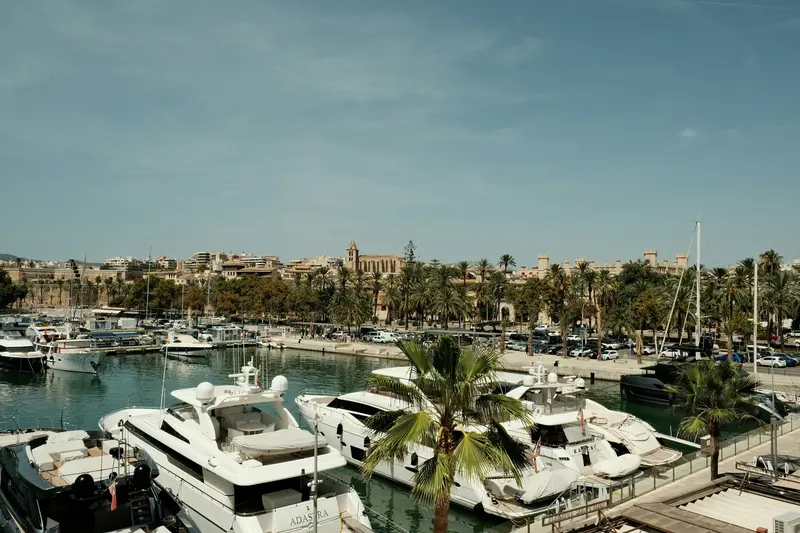
Airport, ferries and where you are staying
Search for Palma de Mallorca Airport or PMI when booking a flight. It lies east of the city. In 2026, airport operator Aena listed the A1 city bus for central Palma and the A2 for the Platja de Palma area. Check the address of your accommodation before choosing a transfer. An address by Palma’s main beach can be far from the cathedral quarter. If you are arriving with a connection from mainland Spain, save your final address and check the onward bus or transfer by district.
For ferries, read the boarding or arrival information for the exact terminal. The passenger docks serve a working port and can be well away from the stretch of waterfront immediately below the cathedral. If you arrive after dark with luggage, plan for that last leg. A room advertised as being by the harbour could be near the old town or several stops away towards the western docks.
Walking through town and going farther by bus
Plaça d’Espanya is a useful landmark. Below it, Estació Intermodal brings together interurban services. Above ground, follow Sant Miquel into the old town past Plaça Major and on to Cort, then continue downhill to Parc de la Mar. To go farther west to Bellver or Cala Major, check the local bus for your exact destination. A stop at the foot of the hill and an arrival at the castle entrance make for different amounts of walking.
From Parc de la Mar, the promenade leads east to Can Pere Antoni and Portitxol. A bicycle is useful if you are aiming beyond the nearest beach. Decide where to turn back and where to leave it before going on into the centre. The lanes of the old town reward walking and frequent pauses. Use the promenade to travel farther and make the historic quarter a separate stretch of the outing.
What to see in Palma
What to see in Palma old town
The most instructive first view of La Seu is from beside the water. Look at the whole silhouette and then walk up to the cathedral square, where the buttresses force your eyes upwards. Head inland from there to Santa Eulàlia. Its church and square give you a pause before Cort, where the town hall faces a square marked by an olive tree. You can carry on through the commercial streets to Plaça Major or stay among the older lanes near the cathedral.
For a shorter circuit, turn into the streets of the Call Major, the former Jewish quarter, and work your way down towards the Arab Baths. Some lanes are too narrow for a good view of an entire façade. Door surrounds and entrance halls repay a closer look, especially when you can see an open courtyard from the pavement. Some entrances lead to private homes, so enjoy the view from the street unless an interior is open to visitors.
Gardens, the merchants’ hall and the old waterfront
The gardens of s’Hort del Rei lie below the Almudaina. Cross from Plaça de la Reina towards La Llotja and pause in the square before you go inside, if it is open. The old trading hall makes more sense once you understand how close the waterfront used to be. The branching stone columns are the main detail to see inside. Follow one up from the floor and look at the point where it splits into the vault.
From La Llotja you can return towards Passeig del Born, where the route leads inland towards shops and squares, or continue towards Es Baluard and the old fortifications. Both are short continuations. If you took the lanes in an unfamiliar order, returning to the water gives a clearer picture of how far west you have walked and where the cathedral sits behind you.
Monuments and heritage
La Seu and the Almudaina Palace
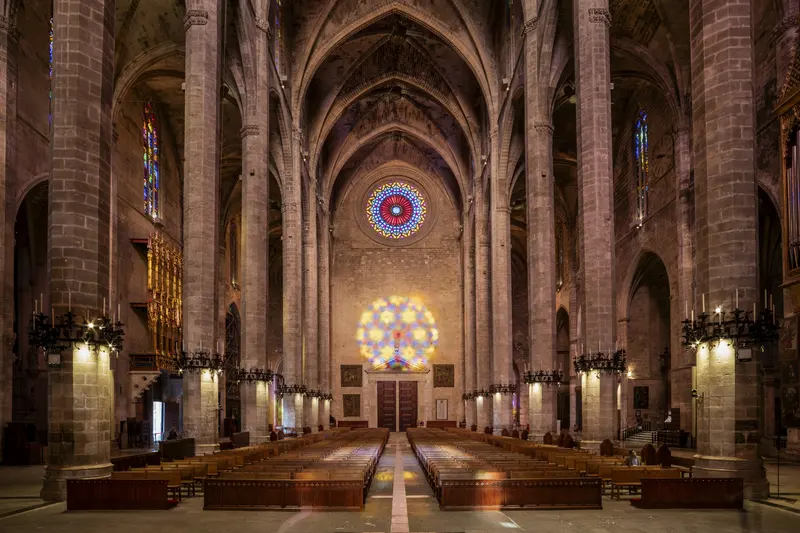
In La Seu, linger where you can see the height of the nave and the distance between its columns. Then turn your attention to the sanctuary and to the changes made to it in different centuries. The canopy belongs to Antoni Gaudí’s liturgical reforms. The ceramic work in the Chapel of the Blessed Sacrament is by Miquel Barceló. You can see both on the same visit. A guided tour of Palma Cathedral is an option if you want help interpreting the architecture and the later work.
Next door, the Almudaina occupies the commanding position of an earlier fortification and retains the character of a royal palace. From outside, look at the relation between the upper entrance, the wall and the gardens. Once inside, use the courtyard to get your bearings before exploring the rooms. Admission is handled separately from the cathedral. If you have booked both, keep some time for the walk along the walls and the lower view from the park.
Castell de Bellver and the Arab Baths
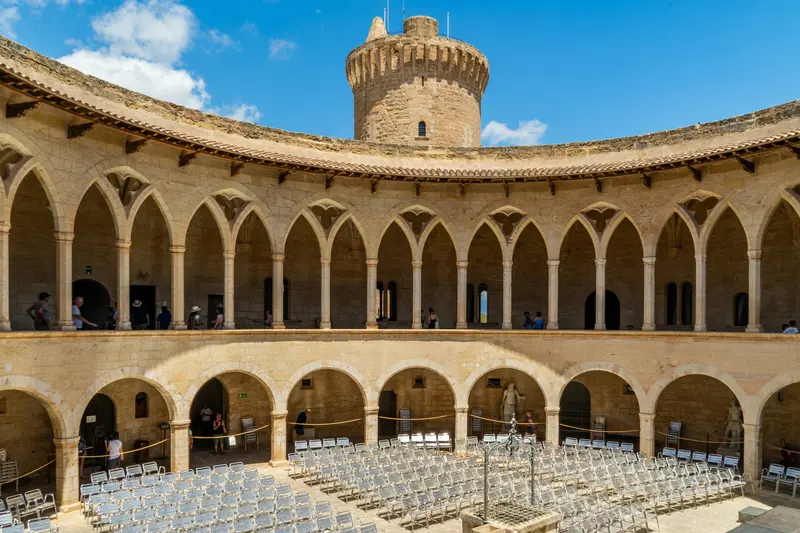
West of the centre, Castell de Bellver is easy to recognise by its circular layout. Look first at the courtyard and then at the arcade above it. Notice how the principal tower stands apart from the main body. Save a few minutes for the bay view after visiting the rooms so that you can turn from the cathedral to the working docks and the beaches further east. The hill is part of the walk. If climbing it looks tiring for your group, plan to meet at the upper entrance.
The Banys Àrabs are on a different scale. In the main chamber, look up to see the openings in the dome and then follow the columns around the room. The small surviving interior gives an idea of how a steam bath worked in Islamic Palma. It fits into a walk between the cathedral and the former Jewish quarter and makes a good contrast with the larger monument above the waterfront.
Museums and culture
Es Baluard Museu occupies part of the old fortifications. The modern galleries are inside and the terraces give a view over the harbour. It fits well after La Llotja because you can approach it on foot along the historic edge of the city. Check the exhibition list before deciding how long to give it. If you have a tight schedule, pick one exhibition and make time for the view from the wall.
Fundació Miró Mallorca is farther west, near Cala Major. At Taller Sert you can see the working space designed for Miró. At Son Boter, an older Mallorcan house, traces of his work sit in a very different sort of interior. The two settings add something to a visit focused on the paintings and sculpture. Check with the foundation which spaces you can visit on your dates, then give the site part of an afternoon and allow for the journey back.
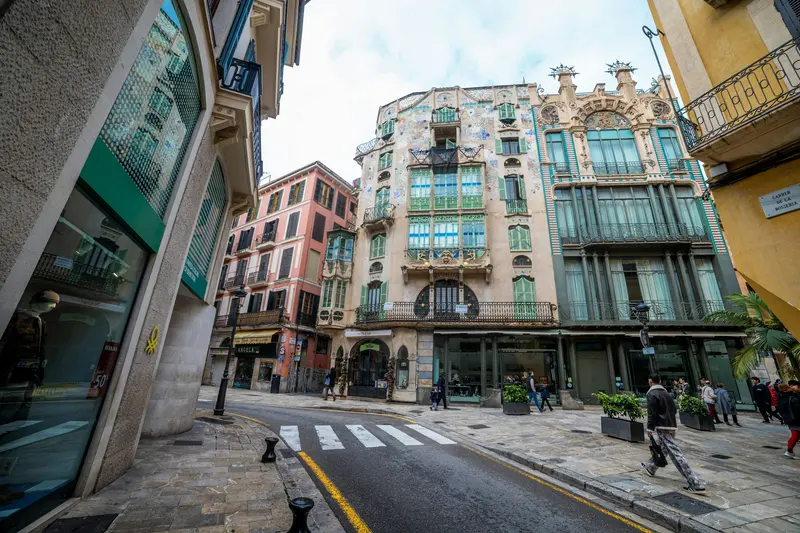
In the cathedral quarter, the Museu d’Art Sacre complements a visit to La Seu. The Museu de Mallorca is another option if you want a longer view of the island’s history. Some art and architecture are visible from the street. In Plaça del Mercat, look for the curved detail on the façades of Can Casasayas and Pensió Menorquina. Then walk to Plaça de Weyler for the former Gran Hotel and see how its balconies and corner are handled.
Neighbourhoods and areas
Cort, La Seu and La Llotja lie within walking distance of one another. Around Cort, much of the visit is about how little squares and commercial streets connect. Around La Seu, the main drama is where the built-up city drops down to water level. Around La Llotja, it is easy to move between the lively square and quieter lanes by the bastion, with the waterfront never far away.
Santa Catalina is just to the west. The streets around the market make a good short walk. Add es Jonquet to see how the old mills mark the ridge overlooking the harbour. This side of the centre is a practical base if you expect to spend time both in the old town and further west. Check the gradient if you plan to walk up from the waterfront.
Portitxol and es Molinar are on the eastern side of the bay. Low houses, small harbours and a continuous walk make this a good place to choose your turning point on the day. Go as far as Can Pere Antoni if you have only an hour to spare, or continue towards Ciutat Jardí if you want a longer afternoon out. Cala Major and Sant Agustí are in the opposite direction and fit better with a trip to Miró’s studios.
Beaches in Palma
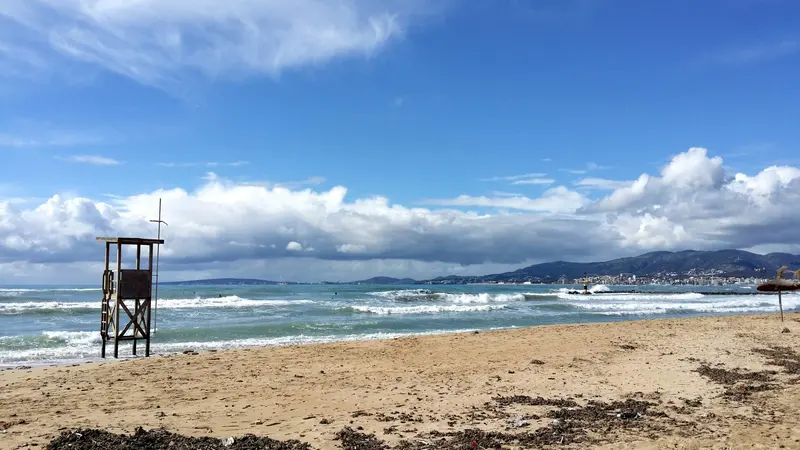
For the simplest beach trip from the old town, follow the promenade to Can Pere Antoni. It is flat along the waterfront and you can see La Seu looking west from the sand. Try it for a short swim or for a walk after sightseeing. If conditions are better for walking than bathing, the same path takes you towards Portitxol.
Ciutat Jardí lies farther east, with breakwaters marking the shape of the shore. In Can Pastilla, compare the compact Cala Estància with the longer sweep of Platja de Palma. If you are coming by bus or staying somewhere along the coast, look for the access point nearest your stop or room. The long beach is often advertised as one area, but where you arrive can decide whether you spend ten minutes walking or make much of the afternoon a promenade walk.
On the western side, Cala Major lies between Portopí and Sant Agustí. It can be combined with the Miró foundation, allowing for the downhill stretch towards the beach. Its sand fills a much smaller gap in the coast than Platja de Palma. Pick it if you are already visiting that side of town, or if your accommodation is near enough to walk back easily.
Festivals and traditions
Sant Sebastià is Palma’s patron saint. The local holiday falls on 20 January in the official calendar for 2027. The traditional revetla is held on the eve of the feast. Visit Palma describes bonfires and music in the city squares. Check the programme for your dates before choosing where to go. The venues can differ greatly in size and a single square may be enough to spend an evening among the celebrations.
Local traditions include correfocs, processions with fireworks, and the figure of the Drac de na Coca. If you are travelling as a family, look for activities suited to children in the programme as well as the evening events. The same part of the centre has a very different atmosphere by day, when you can see the streets and squares without the crowds gathering for the music.
Routes and itineraries

One day around La Seu and the old town
Begin at the water and pick one main interior, La Seu or the Almudaina. Walk to Santa Eulàlia and Cort when you still have time to pause at entrances and squares. Later, head down to s’Hort del Rei and La Llotja, with Es Baluard as an extension if you want a gallery. When you have booked both monuments, keep the rest of the day close to the cathedral quarter so that you still have time for the outside spaces.
Two days with a trip west
On day two, go up to Bellver in the morning and return via Santa Catalina if the hill is part of the attraction for you. For a day centred on twentieth-century art, go to the Miró foundation instead and end at Cala Major. It is worth giving Bellver and the foundation separate visits if possible. Being on the same side of the bay does not make them next-door neighbours.
Three days with time at the coast
On the third morning, walk east towards es Molinar and use the afternoon for the beach that best fits your return journey. Alternatively, see both Bellver and Miró on different days and pair each with a different area of coast. Keeping one half-day flexible makes it easier to use the clearest weather for a view of the bay.
Day trips
Sóller offers a day in the Tramuntana with a side trip to the coast. The historic train leaves from beside Plaça d’Espanya and the tram to Port de Sóller runs separately from the valley. The combined outing takes more time than looking at the railway alone might suggest. Check both journeys and the last usable return. The interurban bus offers another way to reach the valley.
Choose Alcúdia for Roman remains and a walled old town in the same morning. The port takes an extra leg and is worth leaving time for if you want to spend the afternoon by the water. For a short day out in the west, Valldemossa and its charterhouse are enough on their own. Leave time for the streets below the monument before setting off somewhere else.
Travelling with children
Spend part of the first morning beside the pool in Parc de la Mar, then choose one interior nearby. When you are ready to leave the lanes, it is easy to return to open space and see how the cathedral sits above you. At Bellver, ask children to spot how the towers are arranged around the round courtyard. If the climb is too much for the group, save your walking for the castle itself.
For swimming, choose one beach and work out the return in advance. Can Pere Antoni leaves room for a short visit from the centre. Ciutat Jardí and Cala Estància suit a longer outing if the journey is straightforward from your room. When using a pushchair, consider where the nearest suitable access is, especially if moving between a high street and a beach below it.
Where to stay in Palma
Choose the old town for an early start at La Seu and the option of walking back to your room between visits. If you arrive with luggage, check where a vehicle can leave you nearby. Around Plaça d’Espanya, interurban departures are easier and the old town is still on foot via Sant Miquel.
Santa Catalina is a good fit if you plan to divide your time between the old town and the west of the city. Portitxol and es Molinar suit visitors who like an evening walk beside the bay. For a beach-led break, look at Can Pastilla, Platja de Palma or Cala Major. Check rooms on a map and use the nearest stop and the beach access as your reference. A hotel marketed as being in Palma could give you a very different daily journey depending on which side of the bay it is on.
See places to stay in Palma (opens in a new tab)Affiliate link: if you book through it, we may earn a commission at no extra cost to you.