

 Español
 English

Why visit Vitoria-Gasteiz
The shape of Vitoria-Gasteiz becomes clear in Plaza de la Virgen Blanca. One way leads up past the church into curved streets, towers and palaces. At the foot of the hill, arcades lead into the newer centre and across to the gardens of La Florida. Beyond those streets, you can walk beside water at Salburua and see the birds of the Álava plain. Give the capital of Álava province two days to see all three sides. The city also houses the institutions of the Basque Country.
The medieval streets follow the shape of the hill, which explains their name, the Medieval Almond. The lanes that run steeply across them are called cantones. The Ensanche, the district laid out beyond the older settlement, has flatter streets and more room around the squares. Start with a loop from the centre and use it to decide how much of the steep old town you want to explore. Later you can leave the central districts entirely for a walk in the Green Belt.
The main visits work well when you pick one idea for each half day. At Santa María Cathedral you can see how a building was investigated and kept standing. Bibat offers the archaeology of the province and a collection that treats the playing card as an object with its own history. Ataria helps you identify the different parts of Salburua before you choose a path to a bird hide. Give each visit time to lead into the next walk.
When to go
Spring gives you longer daylight for the wetlands. On a changeable day you can start in the old town and move Salburua to the clearest part of the afternoon. Autumn is a good time for La Florida and the wooded walk along La Senda. Both can be shortened easily, so there is room to turn back towards the hill if the light improves. From the Ensanche, a short climb can give you an entirely different view of the day.
Summer brings the jazz festival and La Blanca. If you are travelling for an event, pin down the venue and time before you plan the rest of your visit. A square that normally takes a minute to cross can fill up during a celebration. Leave a separate slot for Santa María Cathedral if you want a quiet morning around the north end of the old town. When the weather turns hot, the open sections at Salburua are better early or late.
In winter, put the hill and wetland paths in the daylight part of your trip. A museum, the covered sides of the squares and a short walk through La Florida make a day that you can adjust to the forecast. On an outing into the province, check which indoor visits are available on your date and how much time the return journey will take. The historic streets close to your room might be a better evening plan than adding a third stop miles away.
Getting there and around
The railway station, coaches and the airport
Trains arrive at the southern end of Calle Eduardo Dato. The same street takes you into the centre and makes a useful reference even if you arrive by another route. The coach station is in the north, near Portal de Foronda. In 2026 the city listed tram and local bus connections from the coach station towards the centre. If you are connecting from a coach to a train, include the walk from the rail station’s nearest useful stop in your travel time.
Vitoria Airport is outside the city at Foronda. Aena listed a bus link in 2026. Check how that service fits your flight before relying on it. Travellers arriving from abroad may find a more convenient route through Bilbao. Compare the complete journey to your room, including any change of bus or station. If you need a car for Laguardia or Salinas de Añana, you can arrange that leg around your stay in the city.
From the hill to the parks
Walk between most sights in the medieval quarter and Ensanche. The shortest line from Cuchillería to Correría can involve a steep climb or descent. With a pushchair, luggage or anyone who prefers a gentler gradient, look for a longer crossing and allow time for it. At Santa María, use the visitor entrance given for your tour. It is worth plotting that exact location before setting off from the hotel or station.
For Salburua and the other parks, look up the particular entrance you want. A map pin headed Salburua can refer to a whole neighbourhood or to a wetland with more than one approach. Ataria is a good target when you want to learn about the lakes before walking. For cycling, the city provides routes that lead from the centre to different parts of the Green Belt. Choose one section and give yourself an easy way back.
What to see in Vitoria-Gasteiz
Virgen Blanca, Plaza de España and the hillside lanes
In Plaza de la Virgen Blanca, start with the monument to the Battle of Vitoria in 1813 and look up towards San Miguel church. From here you can see where the hill starts to rise. Next door, Plaza de España has a regular outline and a continuous view along its arcades. Walk round it before returning to the lanes at the base of the hill. The two squares are close together and give you different ways into the old town.
Take a cantón uphill and follow Cuchillería or Correría. Their names recall the trades associated with the old streets. Instead of retracing your steps from Plaza de la Brullería, return at a different level and look for the lanes that intersect both routes. On a short visit, this adds a useful circuit around the cathedral. With more time, you can stop at a palace or see which places the city includes on its old-town mural route.
Santa María and La Florida
Santa María Cathedral stands at the northern end of the hill. From Plaza de la Brullería you can judge how it sits above the street and against the slope. The foundation’s visitor centre is on Cantón de Santa María. The guided programme explores the building and the work involved in keeping it standing. Check which parts the tour on your date includes. The tower, for example, makes sense if you want a broader view over the city’s layout.
After the cathedral, walk down to La Florida park next to the New Cathedral. It is a change from the streets of the hill and a natural place to pause before going on to La Senda. Follow the garden paths for a short loop or continue along Paseo de Fray Francisco de Vitoria. The houses stand farther apart as you leave the centre. That change becomes apparent before you arrive at the outer end of the walk.
Monuments and heritage
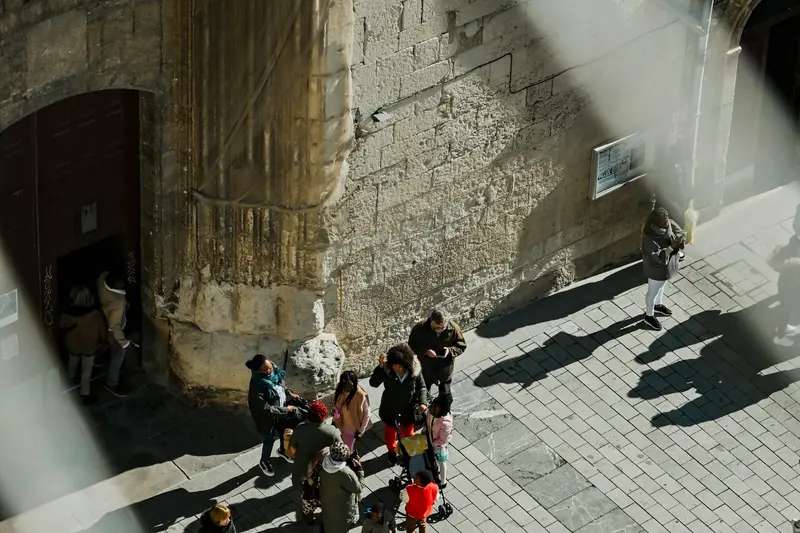
Santa María, the Old Cathedral, developed on the defensive edge of the settlement. The way the earlier buildings and the ground shaped the walls helps explain the cathedral you see today. On a tour, follow these changes rather than trying to attach a date to every detail. If your visit takes you up the tower, look down for the lines of streets you walked to get there. The new perspective makes the curve of the old town easier to recognise when you come back down.
The New Cathedral, dedicated to María Inmaculada, stands at a more open site by La Florida. Walk far enough away from its walls to see how the buttresses frame the Gothic Revival exterior. Putting the two sites on the same day lets you compare the constraints of the medieval hilltop with the scale of a later church that had room to spread out. Allow time to make that comparison from the street before looking at the interiors.
In the old town, the Montehermoso palace and Doña Otxanda tower make useful stops. The palace shows how large buildings were fitted to the upper part of the hill. The tower now houses the natural history museum. For another route, pick one of the churches outside the cathedral’s immediate surroundings. San Vicente, San Miguel and San Pedro each give you a new way of approaching the city streets. They also offer a way to follow the shape of the medieval town without having to start at the same square each time.
Museums and culture
Bibat combines the Álava Museum of Archaeology and the Fournier Playing Card Museum. The playing cards are housed in the Renaissance Bendaña Palace. Look at how the printed images and shapes change from deck to deck. Then make time to see what an excavated object can reveal about a settlement elsewhere in the province. If you are short of time, choose a collection and see it properly. You can come back to the other without having to cross town.
Artium Museoa, on the side of the hill near Calle Francia, focuses on contemporary art. It fits naturally at the beginning or end of a walk through the eastern streets. Leave a break between Bibat and Artium if you visit both. A walk into the old town provides time to take in what you have seen and to look at the large-scale murals outside the museums. If showers come and go, rearrange the walk around the indoor slot that is easiest to keep.
The Fine Arts Museum and the Arms Museum are beside the route towards Armentia. The Fine Arts Museum is in the Augustin Zulueta Palace. For a visit with a local thread, start at the monument to the battle in Virgen Blanca and then look for the Arms Museum’s material on 1813. The public monument and the objects inside the museum serve different purposes. Walking between them turns a brief stop at a statue into a way to learn more about the city.
Neighbourhoods and areas
The Medieval Almond concentrates the sloping lanes, Santa María and several museums. The Cuchillería side works well if you want to stop at Bibat. Correría offers another way round the western slope towards San Pedro. A circuit that climbs on one side and comes down the other is an easy way to see how the streets fit the terrain. It also makes it possible to leave some of the smaller stops until you have seen the hill as a whole.
The Ensanche extends towards the railway station. Its flatter streets let you link Calle Eduardo Dato, Plaza de los Fueros and La Florida without crossing the old town again. Plaza de los Fueros, with sculpture by Eduardo Chillida, has a different relationship to the surrounding streets from the older arcaded square. Try using the Ensanche as an afternoon walk after spending the first part of the day on the hill.
Southwest of the centre, La Senda leads towards Armentia under mature trees. It passes gardens, museums and Ajuria Enea on the way towards San Prudencio’s Romanesque basilica. In the other direction, the Salburua neighbourhood gives access to open ground and wetland paths. Both areas give you more space than the town centre. Pick the southwest for buildings and trees or the east for a walk that puts water and wildlife first.
Nature and protected areas
At Salburua, start at the Ataria visitor centre and choose between paths towards Arkaute or Betoño. The restored wetlands are on comparatively level ground. Water levels and the time of year affect what is visible. At a hide, wait long enough to distinguish small movements from ripples or reflections. Looking for a few birds in one place makes a satisfying outing even if you have time for only one of the lakes.
The Green Belt also connects the Zadorra river, Zabalgana, Olarizu and Armentia. Treat it as a choice of outings if you have a short stay. The advantage of the walk from La Florida to Armentia is that you see the transition from the street to the woods. Salburua makes more sense as a separate outing if watching birds is your priority. Choose an access point before planning a circuit, especially if you are fitting the walk in after a museum visit.
Festivals and traditions
The main La Blanca programme ran on 4–9 August 2026. The festival opens with Celedón’s descent from San Miguel towards the square. At the Lantern Procession, coloured glass is part of a tradition you can also explore at the lantern museum. If you want to see the objects closely, go to the museum on another day and use the programme to choose your place for the public event.
For San Prudencio, on 28 April 2026, celebrations centred in part on Armentia. The provincial programme placed the retreta, an evening gathering with music, on the previous day. The Jazz Festival programmed concerts on 13–18 July 2026, across Palacio Europa, Mendizorrotza and other locations. Look up the venue for the performance you want for a future edition. The two main locations are in different parts of the city.
Routes and itineraries
One day. Start in Plaza de la Virgen Blanca, go through Plaza de España and take a lane up towards Santa María. Use the cathedral booking as the fixed part of the morning. Go round Plaza de la Brullería after the visit and fit in Bibat if you have room for a museum. Make La Florida the last stop and see how far you want to continue along La Senda. The wetland is worth keeping for another period of daylight.
Two days. Give the first to the medieval hill and Ensanche. On the second morning, choose Artium or one of the museums by La Senda, then spend the afternoon on a park. At Salburua, decide at Ataria which lake path works best with your return. For a wooded walk, follow La Senda all the way towards Armentia. Both work as independent outings, so there is little reason to cross the whole city to fit them into one afternoon.
Three days. Keep the first two for the city and set aside a day for the province. Salinas de Añana is a good choice if you want to see a working heritage site. Laguardia has town walls, wine cellars and archaeology. If you are coming back for an evening concert, pick a single excursion and build in time to get to the venue. Another option is to spend the extra afternoon at the reservoir or on a second stretch of the Green Belt.
Day trips
At the Salt Valley in Salinas de Añana, wooden channels carry brine to stepped evaporation pans. A tour helps you follow the sequence from spring to storage to pan. Allow time to walk in the village as well. In Laguardia, combine the painted portal of Santa María de los Reyes with a walk around the walls and a visit below street level. Each makes a different full day out of Vitoria-Gasteiz.
The Ullíbarri-Gamboa reservoir lies north of the city. Choose a stretch of shoreline or start with the Mendixur bird park. A few quiet stops at the observation points will give you a better chance to see what’s around than a rush through the area. For a ride, decide how you want to come back before following the shore. The reservoir and Salburua both bring you to the water, but can occupy very different days of a visit.
Where to stay in Vitoria-Gasteiz
Stay in the Ensanche if you want to walk between the railway station, the squares and the old town. Check whether your address is nearer Eduardo Dato or La Florida. It makes a difference if you are arriving with luggage or leaving early for the southwest of the city. The medieval quarter suits a stay centred on Santa María, the museums and walks at the end of the day. If you will arrive by car, ask your accommodation about the approach to its street.
The coach station area can work well for an early start to another part of the province or a late arrival. Look on the east side if you plan to spend more of the visit in Salburua, and check your route into the centre. In La Blanca or for the jazz festival, judge the position of your room against the actual venue and streets you will use. A central address might put you near one event and across the city from another.
See places to stay in Vitoria-Gasteiz (opens in a new tab)Affiliate link: if you book through it, we may earn a commission at no extra cost to you.