

 Español
 English

Why visit
Santiago de Compostela Cathedral stands at the heart of the old town of Santiago de Compostela. In Praza do Obradoiro, pilgrims emerge from narrow streets and stop in front of a façade that fills almost an entire side of the square. Walk around the building and you will find a Romanesque doorway, a square built on two levels and the door that actually takes you into the basilica. Making that circuit early helps when the time comes to find the entrance on a ticket.
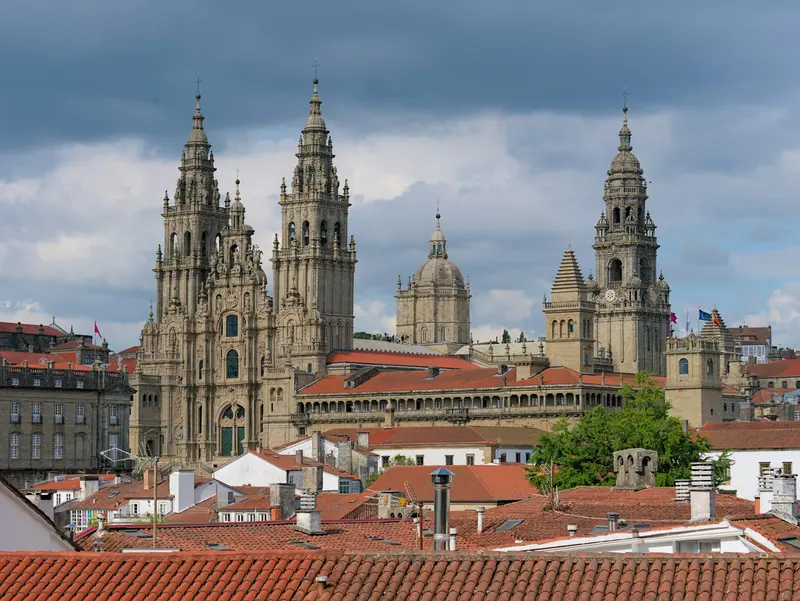
Start halfway across Obradoiro and look above the steps. The towers frame the Baroque front. From there, turn south to Praterías, where the square is smaller and the sculptures sit closer to street level. Inside, the line of the nave draws you towards the high altar and the tomb venerated by pilgrims. The Portico of Glory, the medieval sculpture behind the western façade, merits a slot of its own. Plan the rest of the circuit around that booking if it is the main reason for your visit.
On a longer trip through Galicia, give the cathedral at least half a day for the basilica, a ticketed visit and time in the squares. You can spend a whole morning on the doorways and museum or wait out a shower indoors and walk up to the Alameda when it clears. The surrounding province of A Coruña has plenty for a longer stay. The cathedral and its immediate surroundings work as an entire day on foot.
A short history
According to pilgrimage tradition, the tomb of St James was identified here in the ninth century. A shrine grew into a meeting point for travellers, and earlier churches occupied the site before work began on the large Romanesque building around 1075. Pilgrims were already arriving from different parts of Europe. The position of the tomb helps explain the curved passage around the sanctuary, which allows people to move around the east end of the church.
Master Mateo was documented as directing work on the cathedral in 1168. His workshop designed the western end from crypt to portico and built a stone choir in the nave. The lintels of the Portico of Glory bear an inscription from 1188. The cathedral was consecrated in 1211. Some of the stone choir was scattered after it was dismantled. In the museum you can see how recovered fragments help reconstruct a feature that once occupied a sizeable part of the nave.
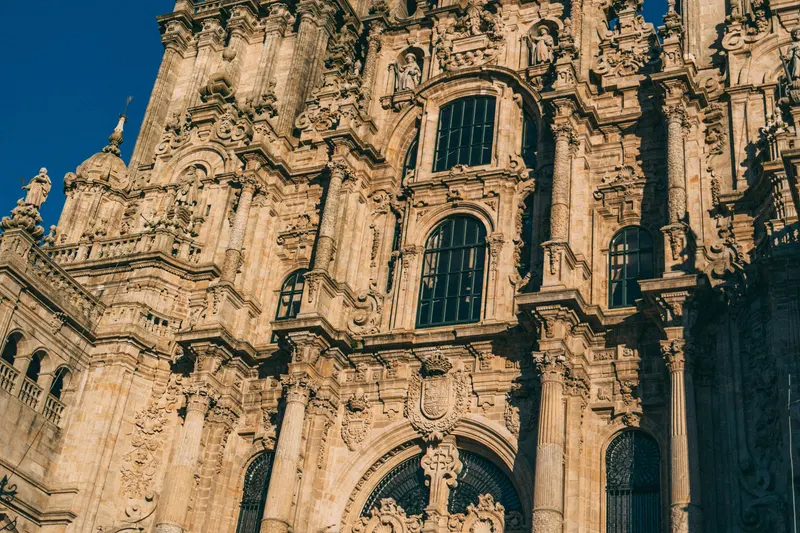
Fernando de Casas began work on the Baroque front in the eighteenth century. From Obradoiro, look at the tall openings between the towers. The medieval portal survives behind that façade, with traces of colour revealed through conservation work. UNESCO added the old town to the World Heritage List in 1985. The listing covers streets, squares and buildings around the cathedral, so you can read the history of the shrine and the city that developed around it on the same walk.
What to see inside
The nave, high altar and ambulatory
From the Praterías door, begin near the crossing, where the side arms of the church meet the main nave. Find somewhere to look east towards the high altar, then turn towards the back of the church. The repeated pillars and arches mark out the Romanesque building. The canopy and gilding draw the eye towards the Baroque altar. Looking along the nave and then across it helps distinguish the stone structure from later additions.
The ambulatory is the curved passage behind the high altar. It links the chapels around the east end. Follow the signs for the apostle’s crypt when that route is open and leave room for the queue to move. The urn beneath the altar holds what tradition identifies as the remains of St James and his disciples. The embrace of the statue of St James is a separate devotional gesture at altar level. If someone in your group would rather avoid steps or a confined space, agree where to meet afterwards.
Portico of Glory, Cathedral Museum and Pazo de Xelmírez
At the portico, start with the central arch. The figure of Christ anchors the composition. Around it, the elders of the Apocalypse hold musical instruments, their heads often turned towards one another. Look lower down for St James on the central column and the carved figures beside the arches. Traces of paint survive on clothing and faces. The cathedral’s account of the restoration explains the case for limiting group sizes and time inside the space.
In the permanent collection, find the reconstruction of the stone choir and then spend a little time in the cloister. The choir gives you a way to picture what the medieval congregation and clergy saw in the nave. The cloister offers a different angle on the towers. The Pazo de Xelmírez, also known as Gelmírez Palace, adds a medieval building associated with the bishop’s household. Check the plan for the crypt of the Portico of Glory. It lies below the western doorway and belongs to Mateo’s work. The apostle’s crypt is at the other end of the building, beneath the high altar.
The roofs and Carraca Tower
The first thing to notice on the rooftop tour is the stone underfoot. The stepped surfaces give you a good sense of how the roof is built. Look towards Obradoiro to find where you started, then identify Quintana and the streets that lead to the market. From this height you can see why some squares connect by stairs. The Carraca or Ratchet Tower also gives you a view towards the Alameda. Choose this tour if you enjoy viewpoints and are comfortable with stairs and exposed heights.
Tickets and opening hours
Which Santiago de Compostela Cathedral ticket should I book?
In November 2026, individual entry to the basilica and the tomb was free. The cathedral’s Spanish visiting page gave daily opening hours of 7 am to 9 pm, with closing at 8:30 pm on summer Saturdays. Visitors used the Praterías door and sightseeing paused during services. Regular Pilgrim’s Mass times in 2026 were 7:30 am, 9:30 am, noon and 7:30 pm. For Christmas, Holy Week, St James’s Day and other special dates, check the liturgical calendar before fixing your itinerary.
These were the published full adult prices for 2026. The booking pages explain which concessions apply to each visit and what proof to bring.
| Visit | Standard price in 2026 | What you get |
|---|---|---|
| Permanent collection | €9 | The museum and other included sites such as Gelmírez Palace. |
| Portico of Glory | €15 | Timed entry and an audio guide, with the permanent collection included. |
| Roofs and Carraca Tower | €15 | A timed guided climb and access to the permanent collection. |
| Full visit | €23 | The portico, roofs and permanent collection. |
In 2026 the museum listed hours of 10 am to 8 pm, with last admission and ticket office closing half an hour earlier. Each booking page lists exceptions. The 2026 portico ticket allowed up to 25 minutes inside, offered an English audio guide and asked visitors to arrive 15 minutes early at the crypt reception on Obradoiro. The 2026 roofs ticket gave about one hour and 140 steps. It also asked for arrival 15 minutes early, at Gelmírez Palace. The roofs booking page listed English and Spanish options for 2026. For a visit in 2027, follow the link for that year on the official ticket portal.
Bags, access and photography
In 2026, the basilica restricted entry with backpacks. The museum purchase policy listed no luggage storage, and the portico and roof tickets also restricted bags, umbrellas and pilgrim staffs. Arrange somewhere to leave them before your slot. Museum rooms and the Portico prohibited photography and recording under the 2026 conditions. The public squares give you room to photograph the façades and take your time changing angles.
In 2026, the roofs had no wheelchair access and the museum’s only lift was at Gelmírez Palace. The Portico ticket also warned that wheelchair access there was interrupted during services. If you need step-free access, give museum visitor services the names of the spaces you plan to see and ask for the best entrance and time before paying. Check the route between the squares as well, as they sit at different levels.
Getting there
From the old town, station and airport
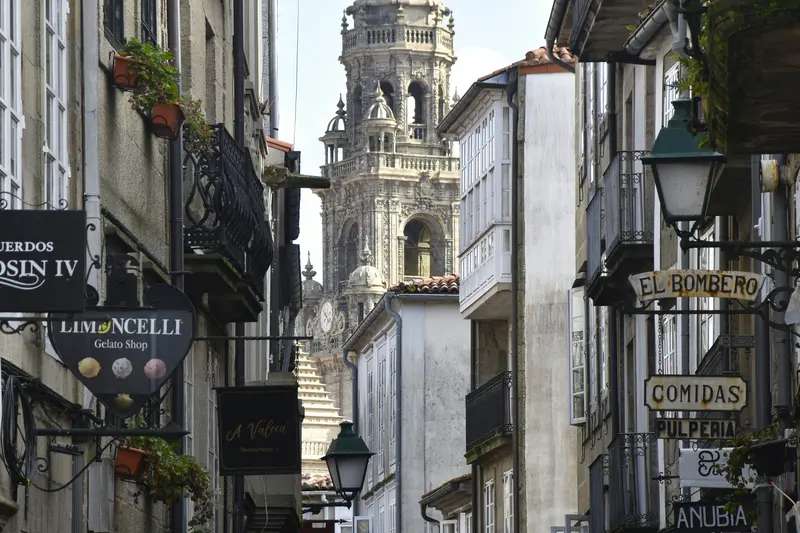
From the Alameda, enter the old town at Porta Faxeira and follow Rúa do Franco to Obradoiro. From the Mercado de Abastos, approach via Quintana to see the eastern side before continuing round to Praterías. Both sets of names are useful on signs and maps. Praterías also appears as Platerías on the official Spanish pages. For a timed booking, head straight to the meeting point on your ticket. Two doors marked close together on a map can still be separated by steps and a detour.
The Intermodal Station served both trains and buses in 2026, south of the old town. The usual walk uphill follows Rúa do Hórreo to Praza de Galicia and on to Porta Faxeira. Allow extra time if you have luggage. The city also had an urban bus from Santiago-Rosalía de Castro Airport in 2026. Check the stop and timetable with Aena and the operator for your travel date. If you drive, park near the edge of the old town and do the cathedral squares on foot.
In 2026, pilgrims who qualified collected the Compostela from the Pilgrim’s Reception Office at Rúa Carretas 33, close to Obradoiro. If you are walking in on the day of your visit, give yourself time to deal with your pilgrim credential and drop off your backpack before a museum slot. These are three distinct stops, even when they are all within a short walk of one another.
Best time to visit
Early morning is a good time to walk the squares and decide which side you want to see in better light. For the basilica, choose a gap between services and allow for the queue at Praterías. If the portico is your priority, pick its slot first and fit the untimed visits around it. For the roofs, choose the part of your stay with the clearest forecast and wear shoes with grip. There is shelter under some of the arcades if a shower catches you between the squares.
On 25 July 2026, the feast of St James, the cathedral scheduled the solemn Mass and National Offering. The museum listed that day as a closure. The cathedral calendar also announced the ceremonial opening of the Holy Door in Quintana for 31 December 2026, marking the start of the 2027 Holy Year. If you are travelling for the jubilee, check the access arrangements for your dates. The Holy Door has a ceremonial role and ordinary visitors follow the cathedral’s published route.
The Botafumeiro is the large censer that swings across the transept. The liturgical calendar lists services at which it is used, while in November 2026 the same page carried a notice of a temporary suspension for restoration. Look for the latest notice before choosing a service on that basis. The façades, nave and portico make a full itinerary on their own, with time left for the squares in daylight.
What else to see nearby
From Quintana to the Alameda
Walk around the east end from Praterías to Quintana and look back from below the staircase to see how the upper and lower squares fit together. Continue to Acibechería, where the mass of San Martiño Pinario makes the space feel narrower, before returning to Obradoiro by Gelmírez Palace. In the square, turn towards the Hostal dos Reis Católicos and Pazo de Raxoi. The former pilgrims’ hospital, the cathedral and the civic palace bring different sides of the city’s history into view.
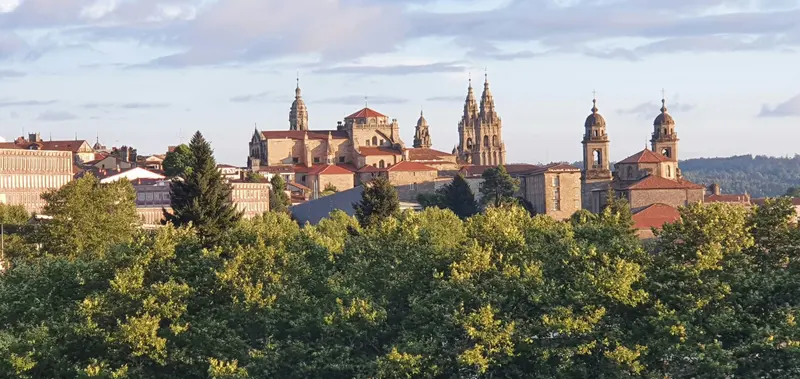
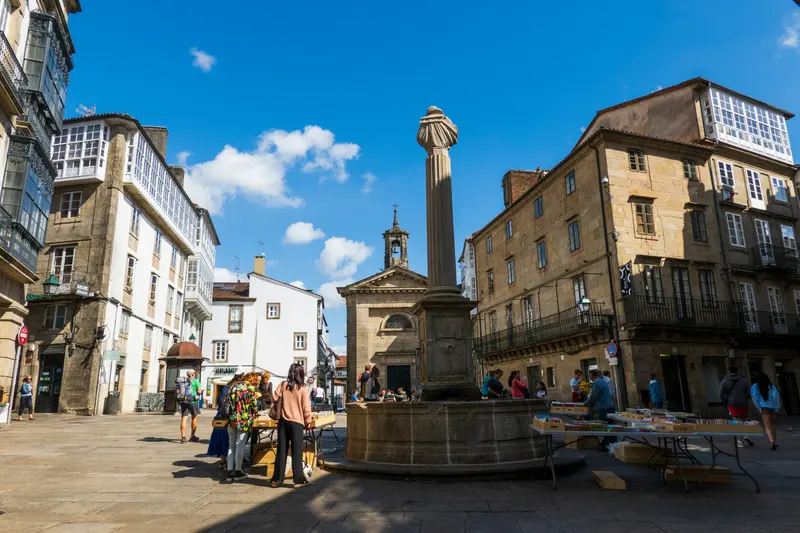
For a short detour, pass through Praza de Cervantes. Its fountain and column give you a landmark where several old town streets meet. If you have another hour, choose the Mercado de Abastos or the Alameda. The market takes the walk east through more of the old town. From the Ferradura promenade in the Alameda, look for the cathedral towers rising in layers above the surrounding roofs. If you climbed the tower, try to identify your route from below. For more Romanesque architecture, walk down to Santa María de Sar and look along its leaning pillars. Keep Sar for after a timed cathedral booking so the uphill return can take as long as it needs.
Where to stay
In the old town, you can walk to Praterías in the morning and drop your waterproof or backpack at your room before the museum. Check the last stretch from the drop-off point, especially with wheeled luggage, and find out which way the room faces if you are a light sleeper. For an early train or coach, the Ensanche is a practical base between the station and the cathedral. Check the gradient of the walk as well as the distance on the map.
If you are finishing the Camino, staying overnight lets you leave the portico or rooftops until the following morning. San Pedro is close to the approach used by the Camino Francés and gives you a different walk back to the cathedral. For a single night, choose your room with the first journey of the next day in mind, whether that is to the pilgrim office, the station or a ticketed entrance at Obradoiro.
See places to stay in Santiago de Compostela (opens in a new tab)Affiliate link: if you book through it, we may earn a commission at no extra cost to you.