

 Español
 English

Why visit San Sebastián de La Gomera
The first walk in San Sebastián de La Gomera can begin as you step off the ferry. Beyond the port are the bay, a town beach and rows of low houses stretching inland along the ravine. The Torre del Conde stands in a park near the shore. Close by, Calle Real leads to Asunción church and the houses associated with the town’s maritime history. Seeing how close these places are helps explain why the town grew around its anchorage.
This is the capital of La Gomera and an entry point to this part of the Canary Islands. A few hours between boats are enough for a walk. An overnight stay gives you time for a museum, a look at the bay towards sunset and an early start inland the next day. Explore the centre and water on foot. Save a morning of its own for the ravines and higher parts of the municipality.
Christopher Columbus’s stop in 1492 is a prominent part of the story told in town. Make room for the years before the Atlantic voyage as well. Finds in the archaeology museum and the history of the 1488 Gomera uprising put the tower, port and streets in a wider context.
When to go
Mild winters on the east coast make the old town and promenade suitable for year-round visits. On hot summer days, plan to go inside a museum in the middle of the day after walking round the port. A clear morning makes it easier to see Tenerife from the shore. If cloud closes in, the lanes between Asunción church and the tower park still make a good starting point.
For Los Roques or the ravines, check the weather at the height you plan to reach. Visibility and temperature can differ markedly from the beach. Keep the higher walk for another time if needed and begin with the museum, waterfront or a viewpoint lower down. With two nights, you can switch the order of an old-town visit and a drive inland.
September is a good time to combine a walk with the Jornadas Colombinas. The programme changes each year and some events take place outside the capital. Look for an event that matches your dates before booking a night especially for it.
Getting there and around
Arriving by ferry or plane
Official travel information checked in 2026 includes the crossing from Los Cristianos in southern Tenerife to San Sebastián. If flying into Tenerife, allow time to get to the ferry terminal and follow the check-in instructions on your ticket. The crossing lands near the route between the town centre and La Cueva. For the return, use the entrance shown by your operator and allow time to collect luggage or return a car.
La Gomera Airport is in the south, near Playa de Santiago. Reaching the capital from there involves a separate road journey. The island transport information checked in 2026 lists buses for the transfer. If you rely on one, look up the departure for the right day and where it drops you off. Flying into the island gives you a different first afternoon from arriving at the harbour.
Walking around town
Plaza de las Américas, the tower park and Calle Real are close enough to explore on foot. Use the church to get your bearings on the way to San Sebastián chapel, and the park to find the beach again. The route up towards La Lomada and the Parador adds a climb. Check how far your accommodation is from the lower streets, especially if carrying luggage or avoiding steep slopes.
If using the capital as a base for a trip inland, plan the afternoon return. Buses reach several towns and villages, but the stop with a village name may sit some way from the path you are looking for. Drivers can group stops along the same road and keep the town’s waterfront for a day when the car can stay parked.
What to see in San Sebastián de La Gomera
From the Torre del Conde to Calle Real
Start in the park around the Torre del Conde. The lawn gives you room to see the proportions of the fortification and the lower buildings around it. Circle its perimeter before walking to Plaza de las Américas. The square opens towards the sea at the junction of the routes from the port, the beach and Calle Real. It is a useful place to meet again if your group splits up.
On Calle Real, look up above the shops. Near Asunción church, doorways, balconies and roof edges show a different side of town from the buildings facing the water. Casa de los Quilla, opposite the church, has a timber balcony enclosed with latticework. Stand back to see how the wood screens the balcony from the street. Explore the side lanes before returning to the square.
The well and the houses connected with the crossing
Casa de la Aguada preserves a well associated with provisioning ships. Local tradition links its water to Columbus’s voyage. The well gives you a way to think about how a harbour supplied fresh water to people about to leave on a long crossing. Locate the house in relation to the square and the old waterfront to see what made the site useful.
When open to visitors, Casa de Colón extends the story into pre-Columbian art. The name marks a place of memory in the streets of the old town. Pair it with the archaeology museum to see something of Gomera before the conquest as well as the later relationship with the Americas. If there is time to go inside one building, pick the part of the story you want to follow further.
Monuments and heritage
The Torre del Conde is a fifteenth-century Castilian fortification. Its thick walls provided a place of refuge for the ruling powers, including during the 1488 uprising. From outside, look at the ground plan, heights and openings in the walls. Then compare the tower with the open plaza where town life plays out today. The surrounding park allows a view from several sides.
Asunción church combines features from several periods after rebuilding and alterations over the centuries. Look at the entrance and where the façade meets the street. If the church is open, allow time for the interior and its sacred art. When a service is in progress, stay with the square and neighbouring houses.
Continue to the chapel of San Sebastián, dedicated to the patron saint of the town. Its smaller scale is clearer after visiting Asunción. Some of the houses between them retain their courtyards and timber balconies. Across from the main church, Casa de los Quilla adds an example of late eighteenth-century domestic architecture to the walk. If you came to see the houses from the outside, follow the street in both directions around the square. The view changes between the broad church frontage and the narrower plots opposite. The quieter side streets also leave room to stop and look up at the woodwork without standing in the middle of Calle Real.
Museums and culture
The La Gomera Archaeology Museum occupies Casa de los Echevarría. Look for the wooden coat of arms on the façade before going inside. Objects and reconstructions introduce ways of life on Gomera before the conquest. Begin with objects associated with daily work and see how the display moves into beliefs and rituals. The visit gives you a way to think about the landscapes you will later pass by road.
The panels in Spanish and English help if people in your group read different languages. Check opening information before arranging the whole day around the museum. If time is tight, focus on one room and continue along Calle Real. Casa de Colón, in a house from after the early Atlantic crossings, adds the pre-Columbian art from Peru described by the island tourism office.
Neighbourhoods and areas
The centre and port. The pier, square, promenade and shopping streets follow one another into the old town. You can step indoors for a visit and still have time free by the water before boarding. Torre del Conde park is close to the main walking route and makes a useful place to meet up.
La Lomada and the Parador side. The town rises on the eastern slope and opens up views over the bay. Consider the climb if you plan to walk back up every evening. From this side you can see both arms of the harbour and how the built-up area fits between the slopes.
Villages inland. The municipality extends well beyond the old town. La Laja sits at the head of a ravine reached by road. Spend a rural morning looking at the shape of the valley and return to the waterfront in the afternoon. Check the actual village when an address refers only to the municipality.
Nature and protected areas
Los Roques Natural Monument includes several rock formations on the ridge between the upper reaches of La Laja and Benchijigua. From the designated viewpoints you can pick out Agando and the nearby rock spires. Erosion uncovered bodies of rock that formed below the surface. Look at where they rise above the road and at the slopes falling away on both sides. Consider coming back if they disappear in mist.
Benchijigua is a protected nature reserve with species native to the island. Check where visitors can go to view the ravine. Designated viewpoints give you a way to see the terrain without entering sensitive areas. The La Laja viewpoint offers another view of a steep valley within the same municipality as the busy strip of coast around the port.
To the northeast lies Puntallana, with exposed shores and the chapel of Virgen de Guadalupe. Once you see the surroundings, it is easy to understand why a visit feels like an outing from town. Check whether you can get there before setting aside part of a day for the detour.
Beaches in San Sebastián de La Gomera
Playa de San Sebastián. This beach has volcanic sand and lies on the town side of the bay, near the promenade. You can stop between parts of the walk while the centre stays in view. On clear days Tenerife appears on the horizon. Read the signs and look at the shore before swimming, even when the bay appears calm.
Playa de la Cueva. On the other side of the port, the setting changes to a rocky backdrop and dark sand. Look for the Olympic torch monument, a reminder of the flame’s passage and of Gomera boxer Marcos Chinea’s participation in the 1968 Mexico City Olympics. If catching a boat afterwards, give yourself time to follow the marked route back to the boarding area.
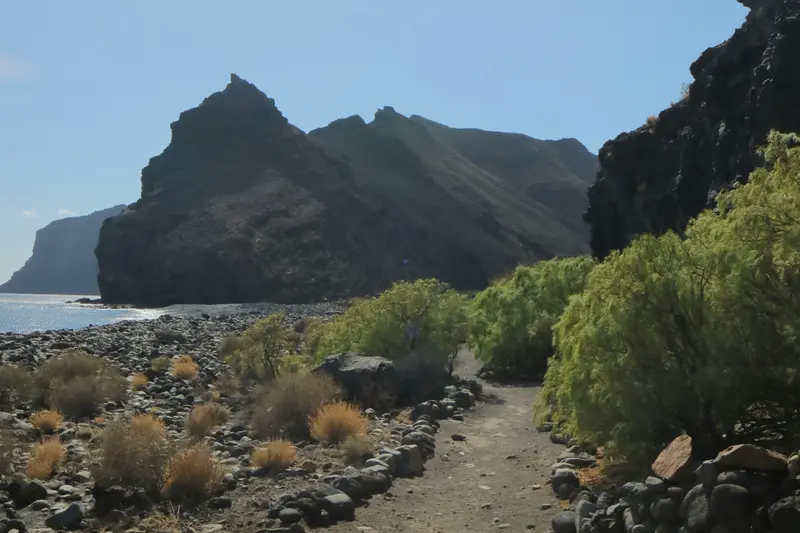
El Cabrito. This beach lies at the foot of its own ravine. The island’s 2026 map includes it on the long trail from San Sebastián to Playa de Santiago. Set aside time to organise it as a separate outing. Choose one of the two town beaches if your ferry leaves soon.
Festivals and traditions
The Jornadas Colombinas recall the Atlantic voyage through a cultural programme. The 2026 edition ran from 2 to 18 September according to the island council. Its range of events makes it possible to link a morning of local history with an evening cultural visit. For a later edition, check the full programme and the venue of each event.
Devotion to Virgen de Guadalupe, the island’s patron, centres on the chapel at Puntallana. The five-yearly Bajada brings people from across Gomera together to accompany the image to the capital. Visiting the chapel and Asunción church helps explain the connection even when there is no procession. Check that year’s announcement if your visit depends on following the route.
Sport and outdoor activities
The 2026 island trail map marks a 9.8 km route from San Sebastián to Degollada de Peraza with more than 1,000 metres of ascent in that direction. Walking it gives you a sense of the change between the coast and the middle elevations. Arrange the return from the higher point and check the trail condition first. A walk from the port to La Cueva is easier to fit in when you have only a few hours.
The trail to Playa de Santiago by way of El Cabrito, graded difficult on the same map, covers an entirely different scale. The distance and climbing make it a day’s outing of its own. For an easier outdoor day, stay around the bay and pick a viewpoint you can reach by road.
Routes and itineraries
A few hours between ferries. Walk from the port to the Torre del Conde, cross Plaza de las Américas, then follow Calle Real to Asunción. Pick the archaeology museum or Casa de la Aguada as your main stop if it is open. Finish in the park or at the town beach for a short walk back to the ferry.
One day in town. Spend the morning in the old town, including the chapel and museum. After that, cross the port area to Playa de la Cueva. If you are more interested in the landscape than swimming, swap the second beach for a walk to the higher side of the bay. Finish in the square once you have seen how the districts connect to the waterfront.
Two days with a ravine or a forest. Walk around town on the day you arrive and spend the next morning around La Laja and Los Roques, or in Garajonay. One longer stop inland gives you a better sense of the forest and relief than several short detours. Plan the drive back around the place from which you will leave the following day.
Day trips
For a day on the north side, pair Hermigua with Agulo. The first lets you see the shape of the valley and the second has an old town tucked under the Abrante cliff. If you are going up to the viewpoint as well, trim the number of stops. On a misty day, spend longer in the village streets and museums.
To the west, Valle Gran Rey makes a day of ravine views and coast. The descent follows a drive across the interior, so leave time to see the lower valley on foot. If you have a ferry the same day, La Laja or a longer old-town walk is easier to fit in. For Garajonay, choose the trail according to the side of the island you will approach from, and check the access details before leaving.
Travelling with children
With children, link the tower park and the square for an easy first walk. Circle the tower outside and shorten the route if it is hot. At the museum, choose a few objects connected with life before the conquest and keep part of the day for time outdoors. Along the bay, find a place to watch the ferries manoeuvre from outside the boarding area.
Where to stay in San Sebastián de La Gomera
For an overnight stop between ferries, the lower old town and the streets around Plaza de las Américas offer short walks from the port. Check where the entrance is and how you will reach it with luggage. The town beach puts a waterfront walk within reach at the end of your day.
The approaches to La Lomada and the Parador give wider views along with a steeper walk. For several days of driving, check where you can leave the car and how you will get to the main roads. If your visit centres on the ferry and sights within walking distance, start your search in the lower part of town.
See places to stay in San Sebastián de La Gomera (opens in a new tab)Affiliate link: if you book through it, we may earn a commission at no extra cost to you.