

 Español
 English

Why visit Maó
Start above the harbour if you are deciding what to see in Maó. From the upper town you can follow the water through successive narrows towards the Mediterranean. Down on the quay the view runs the other way, up past the stairs and the houses built right against the edge. In a single day you can explore both levels, visit a museum and make sense of the islands and fortifications you might see on a second outing.
Maó, also known as Mahón, is the capital of Menorca in the Balearic Islands. It is a practical base for the east of the island. The town has transport links and museums, while Es Grau and Sa Mesquida offer two different ways to reach the coast. With two days, give the town one and use the other for wetlands, archaeology or a harbour crossing. The upper town is compact. Seeing the whole harbour takes longer because the islands and both shores have different approaches.
When to go
Spring and early autumn give you enough daylight to visit the upper town and stay by the water after a museum has closed. Check which interiors you can see first if the visit is mostly about history, then choose the part of the harbour you would most like to walk. For a boat trip, leave a little flexibility around the departure if conditions change.
In summer, the squares and viewpoints are easier to enjoy early in the day. Down at the water there is often more breeze, but the quay still has stretches without shade. At Es Grau you can choose between a walk by the lagoon and an hour on the sand depending on how much sun your group wants. If you are spending the afternoon in town, check the museum’s opening periods before relying on it for the hottest hours.
In winter, plan around a museum, the churches or a string of short walks. Wind around the harbour entrance and at Favàritx can change an outing considerably even when it is mild in town. With two days at your disposal, use the clearer day for whichever view matters most, be it the north shore, a path by the lagoon or the walk under the upper town.
Getting there and around
The airport, bus station and ferry port
Menorca Airport appears as MAH on bookings. In 2026, airport operator Aena listed bus 10 for Maó bus station. Check the service for your date and the onward connection if you are going beyond the centre. If you are taking an early flight home, plan for the trip from your room to the airport separately. Maó’s bus station is also the place to look for an onward service towards the middle of the island or Ciutadella.

For a ferry arrival, find out which part of the harbour your ticket names. The waterfront is long and the moorings used for local excursions serve another purpose. Save the terminal for the ferry and the starting point for any shorter boat trip, especially if you are crossing to Illa del Rei. If you pick up a hire car near the airport, consider leaving it parked during your first visit to the streets of the upper town.
Finding your way on both levels
The upper town links most of the central squares, museums and viewpoints. Before heading to the water, check whether the suggested way down uses steps or a slope. The harbour may look narrow from a viewpoint. Road journeys round it can take you some way inland first, particularly when you are bound for the far shore.
Treat Illa del Rei, La Mola and Es Castell as three separate outings. The first is reached by boat. The fortress has its approach on the north side and Es Castell is east of town on the southern shore. Choosing one for an afternoon leaves room to get there and to look around without losing the earlier visit to the town centre.
What to see in Maó
Plaça de la Constitució, Santa Maria and the Carme
Begin in Plaça de la Constitució, near the town hall and the church of Santa Maria. Go inside the church if the doors are open to visitors. The large organ is a good reason to look up before you leave. From the square, take the lanes towards the Carme and watch how the buildings draw close before the next space opens out.
The Church of the Carme and the neighbouring cloister form part of the same complex. The old cloister now houses a market. Take a moment in the courtyard to see how the passages face inwards. A few minutes later, Plaça de la Miranda turns the view out across the harbour. Try a route through the inner lanes on the way out and return along the upper edge. The difference is one of the pleasures of exploring this part of town.
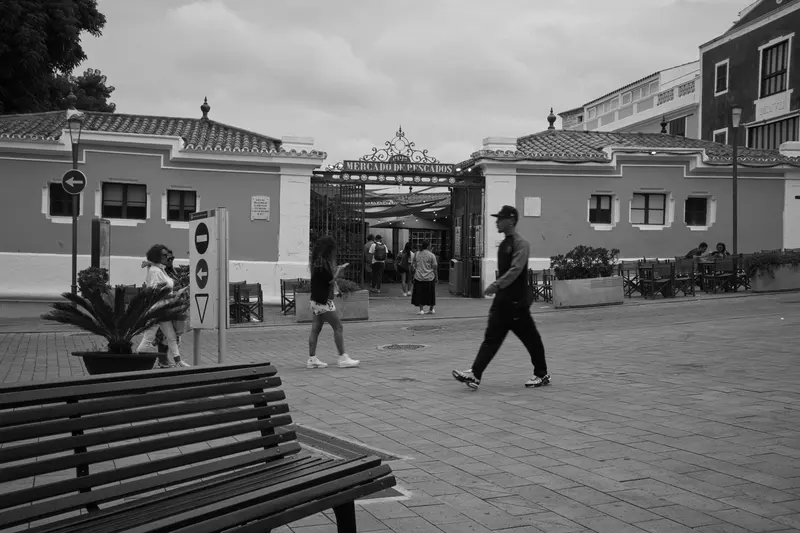
Viewpoints, Moll de Llevant and Illa del Rei
Before going down, find the far shore and see if you can work out where the entrance to the harbour lies. Once you reach Moll de Llevant, the cliffs reveal stairways and façades that were hidden from above. Follow the quay for as much or as little of the afternoon as you have left. To see the islands and shores from the channel, compare boat trips around Maó harbour and check which quay the tour uses.
Illa del Rei gives you a view from the middle of the harbour. The former naval hospital and the contemporary art centre occupy different buildings. Check what is open at both, then build the visit around a confirmed outward and return transfer. Estimate how long you will actually have on the island between boats. If you are also using the ferry port that day, do the island visit on a different afternoon.
Monuments and heritage
Sant Roc, Carrer d’Isabel II and the harbour defences
Pont de Sant Roc preserves part of the old town defences. It makes a good landmark on the route between the historic streets and the open space of La Explanada. Walk along Carrer d’Isabel II for some of the larger town houses. Look for projecting enclosed windows among a mix of architectural styles. They are one of the easier features to spot from the street and show the British influence on the town.
La Mola, formally the Fortress of Isabel II, is a nineteenth-century complex at the entrance to the harbour. Give it more time than an urban monument. There is ground to cover and the route climbs and falls. Check the sections open when you plan to go and decide how you will reach them. Fort Marlborough, near Es Castell, offers a different view of the arrangements for defending the harbour, from the other shore. The two can make better outings on separate days.
Trepucó and Talatí de Dalt
At Trepucó, within reach of town, there is a talayot and a taula enclosure. A talayot is a massive stone structure. A taula has a slab resting across the top of an upright stone, giving it a recognisable shape. Look at both in relation to the ground around them. The prehistoric sites of Talayotic Menorca were inscribed on the UNESCO World Heritage List in 2023.
Talatí de Dalt, further inland, has a striking taula with another stone resting diagonally against it. Spend time on the extent of the settlement as well as the best-known monument. If you can fit in only one site, choose for the journey and time on foot that suit you. Afterwards the archaeological finds at the Museu de Menorca fill in another part of the story of these places.
Museums and culture
The Museu de Menorca occupies the former convent of Sant Francesc. Its cloister helps make sense of a building that now houses material from across the island, from prehistoric finds to more recent objects. Combine the museum with Trepucó if you want to move between the remains in the field and what archaeologists have found and brought inside. From the surrounding streets you can see how the convent sits on high ground near the harbour.
Ca n’Oliver is a town house with collections to see inside. Notice how the staircase leads to a change in the scale of the rooms as well as a change in the things on display. It is easy to put on the same walk as Carrer d’Isabel II or the Carme. If you are staying the night, check what is on at Teatre Principal, a theatre inaugurated in the nineteenth century. Pass its entrance on Carrer de ses Moreres even if a performance falls outside your dates.
Neighbourhoods and areas
The high part of town takes in the commercial streets, Carme and Sant Francesc, along with residential lanes. La Explanada is a landmark further inland and comes in handy when crossing the centre on foot. A room there lends itself to a different kind of day from one down by the moorings. Consider which route you will make most often, whether it is to the bus station, the quay or the museums.
Below, what people call the harbour is a series of places along a long shore. Name the quay if meeting someone and specify which side you are on. For a stay at water level, locate the climb you would use for an evening or morning in the older streets. It matters much more if you plan to do it more than once a day.
Es Grau and Sa Mesquida are coastal settlements within the municipality. In Es Grau, you can see the connection between the lagoon and the bay. At Sa Mesquida, the small settlement sits near rocky shore with a beach beyond it. As bases they favour the coast and change the way you reach the centre. Work out how you would get back after a meal in town before committing to daily trips.
Nature and protected areas
S’Albufera des Grau and the sa Gola channel
The natural park includes a lagoon, coastal habitats and dunes. Close to Es Grau, the sa Gola walk takes you along the channel joining the lagoon to the sea. Within a short distance you can see the changes in vegetation, water movement and shelter. Pause at a designated viewpoint to look for birds at the edge before walking on. A short visit can be rewarding if you give some of it to standing still.

The terrain around the lighthouse at Favàritx is open and rocky, with a different feel from the edge of the lagoon. If trying to do both in one day, check access to each part of the park independently. The arrangements can vary with the season. Give yourself time to explore your preferred area. A circuit along one shore can be a better use of the afternoon than two quick stops at opposite ends of the park.
Beaches in Maó
Es Grau and Sa Mesquida
Es Grau has a sandy shore with shallow water near the beach. It suits a visit split between the sea and a short walk around the lagoon. From the village, look at where you join the beach and where the path back to the channel begins. If you are combining both with children or carrying beach gear, it helps to pick one place to turn back.
Sa Mesquida has a more open setting, with rock visible around the bay and a sandy stretch beyond the settlement. Look at the water from the approach and choose how much of your time will be on the shore that day. Allow two outings if you want to swim at both beaches and choose the order according to the wind. Even a short stop at Sa Mesquida will show a different side of Maó’s coast after Es Grau.
Favàritx and beaches in the natural park
Cala Presili and Cala Tortuga are in a rockier, more open landscape. Reaching them involves walking, so count the return as part of the excursion. Follow the signed paths and check how to reach Favàritx on your date. For a small outing that can be cut short if needed, the village of Es Grau is more convenient. Save the farther coves for a day you can organise around a walk.
Festivals and traditions
Maó’s Festes de la Mare de Déu de Gràcia bring horses and festivities into the town centre. In 2026, the main days were 7 and 8 September. Find the official programme for your year and look at the event locations as well as timings. A walk between a square and the waterfront can be slower while the processions are on. If travelling with children, choose a place from which you can move away easily.
Outside the festivities, a programme at Teatre Principal or one of the museums is another way to see how the city is used by the people who live here. If an event is in the evening, schedule the trip to the park or harbour earlier so that you have time to get back to the upper streets.
Sport and outdoor activities
The Camí de Cavalls from Maó towards Es Grau shows how the landscape changes between port and protected coast. Locate the point where you want to join and look at the ground you will cross. If aiming to finish somewhere else, resolve the return first. A short out-and-back walk from Es Grau lets you see the trail without relying on a separate transfer.
Time on the water comes in different forms. A harbour trip suits a first look at the defences and islands. Paddling near Es Grau is more dependent on the wind beyond the launch point. Ask the provider where the activity runs and how the route changes if it gets gusty. If you have one clear weather window, use it for the single stretch you most want to see.
Routes and itineraries
One day. See Santa Maria, then make for the Carme and the Miranda viewpoint. Pick either Ca n’Oliver or the Museu de Menorca if you want to spend time inside. After lunch, go down to Moll de Llevant. For a harbour trip, place the boat departure first and use either side of it for a walk along the quay.
Two days. Keep one day for town and harbour. On the other, walk around part of the lagoon and spend time at Es Grau beach if it suits the weather. To focus on military history instead, give La Mola its own outing and allow time to see the harbour entrance. You can swap the days if you have a booking dependent on conditions.
Three days. Add Trepucó or Talatí de Dalt and spend time in a collection after visiting the stones on site. Use the remaining part of your third day for a short visit to Sa Mesquida or for a last look at the harbour from the high part of town.
Day trips
Es Castell’s Cales Fonts has a waterfront on a smaller scale than the quay in Maó. Continue to Cala Sant Esteve and Fort Marlborough if there is time and the fort is open. This outing works particularly well after you have seen the harbour from the capital. The route shows how much the viewpoint changes when you move towards the entrance along the southern bank.
Ciutadella is the island’s former capital. Starting early gives you time for the Born, the harbour and a walk through the old lanes. If adding Naveta des Tudons, give that part of the trip a clear route there and back. One full day in town can also work well without combining it with an inland stop.
In Fornells, climb from the quays to the tower for a different sort of harbour entrance. Add Es Mercadal inland or Cala Tirant on the north coast if you have a day to spare. Arrange the rest of the outing around the return if you book a session on the water.
Travelling with children
Link the cloister and the Miranda viewpoint for a short route with a seaside view. If using a pushchair, choose a suitable way down to the harbour beforehand. At the bottom, pick a visible point to walk to and head back when you reach it. There is plenty to see around the moorings on a short walk.
At Es Grau, combine a little time on the sand with a look at the channel. At La Mola, check the type of route and shade before setting out with younger children. One principal visit leaves you room to adjust the afternoon for different ages. A family trip to the park can work well with just one of the short walks.
Where to stay in Maó
Stay in the upper town for museums and places you can reach on foot. Near La Explanada, look at the distance from your room to the bus station as well as the streets you will use in the evening. Rooms near the harbour are handy for walks at water level. Check the route up to town if you expect to do it frequently.
Es Grau is a base for the park and the beach, with a different trip into town. For an early flight or visits on both sides of the harbour, staying in Maó itself can simplify the journey. When choosing a room, save the full street address and check the name of the settlement so you can tell which routes will actually start on your doorstep.
See places to stay in Maó (opens in a new tab)Affiliate link: if you book through it, we may earn a commission at no extra cost to you.