

 Español
 English

Why visit Jerez de la Frontera
To get your bearings in Jerez, start at Plaza del Arenal and head to Alameda Vieja. The walls of the Alcázar are straight ahead. Walk downhill towards the cathedral and you pass vast sherry cellars. Seen together, these buildings explain why a large part of the city’s story fits on a short walk: a fortified town, a religious centre and a wine industry that needed room to age its stock. From here you can walk to San Miguel and across the centre to Santiago.
The city of Jerez sits inland from the bay in Cádiz province. It deserves time of its own on an Andalusia trip if you are interested in flamenco, sherry or horses. Separate bookings from the places you can see at any time. You can adjust a route around the squares when the weather changes. Plan the rest of that day around an exhibition or a cellar tour with a fixed start.
With a morning, see the Alcázar, cathedral and Arenal. With a full day you can go inside a museum, take a tour or visit the equestrian school. A second night makes sense if you want to hear flamenco without fitting the walk through its neighbourhoods into the hours before your return train.
When to go
Spring and autumn work for days spent between courtyards, churches and squares. The Alcázar has open spaces and rooms you can step inside along the way. If you are visiting for a fair or festival, plan around the venues and dates in that year’s programme. The fairground and Teatro Villamarta are in different parts of the city.
In summer, do the longer walk early, before the streets heat up. A courtyard and the interior of a cellar feel very different at the same time of day. Use sunny stretches for short connections and return to Plaza del Arenal and Plaza de la Asunción once the light starts to soften. When choosing a route back to your room, look for shade as well as distance. A wide avenue can feel quite different from the streets between the squares.
In winter, cluster the visits by neighbourhood. With rain in the forecast, pick the cathedral, a museum and a nearby cellar so that you spend little time walking between them. Keep the trip to Laguna de Medina for a clear spell if you are going mainly to see the countryside and birds. Water levels there change with the season and rainfall.
Getting there and around
Jerez’s airport is outside the city. In 2026, airport operator Aena listed rail services to Jerez and along the bay corridor. Check departures for your arrival day before counting on a train from the terminal. Look for Aeropuerto de Jerez when you mean the airport and Jerez de la Frontera for the city. If arriving from abroad, compare a flight to Seville and onward travel as well, especially if Seville is already part of your trip.
The railway and coach stations in Jerez are near each other. Start by walking to Plaza de las Angustias, then head towards the Arenal or San Miguel depending on your plans. If your first visit is booked for a particular time, allow for getting out of the station, finding the right streets and locating the visitor entrance. The monuments are clustered near the centre, but the walk from the station still takes part of your morning.
In 2026, Renfe listed Jerez on the Cádiz commuter rail network. For a day trip, consider where you will finish and which station will work for the return. In the bay towns, the closest station to the old centre may feel much further away from a beach. Work backwards from your last stop rather than assuming you will leave from the place where you started.
If driving to the Alcázar, cathedral and historic streets, plan to park once. The streets around Plaza de la Asunción and San Mateo are easier to explore on foot. To reach the equestrian school, you can build a walk around Porvera and Santo Domingo. For the Cartuja monastery and Laguna de Medina, plan a separate leg instead of going back and forth between town and countryside throughout the day.
What to see in Jerez de la Frontera
The Alcázar, Alameda Vieja and cathedral
Start outside the walls, where Alameda Vieja gives you space to see the outline of the Alcázar. Inside the fortress, look for the former mosque, baths and courtyards. Together they show how a defensive enclosure also made room for worship and everyday uses. Move between the rooms before looking into the gardens. If you take time over the first visit, keep your next stop flexible.
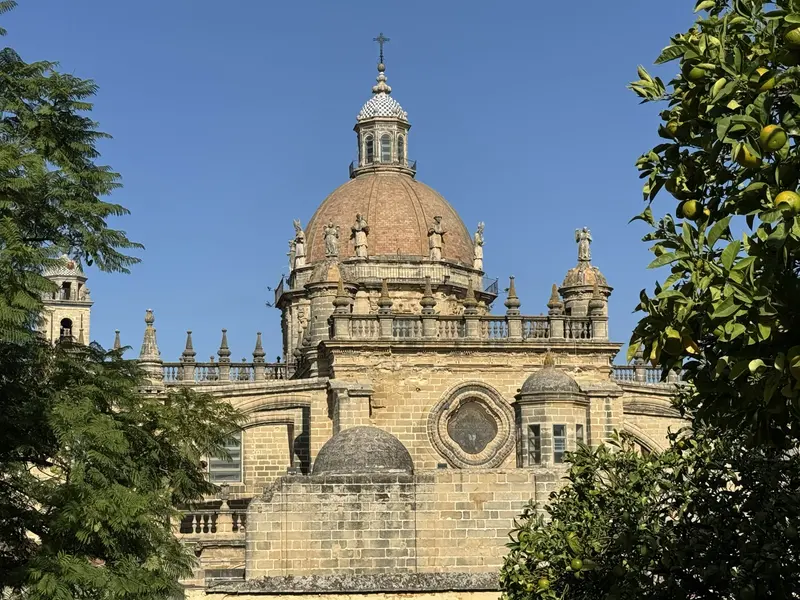
Walk down towards the cathedral. The size of the cellars around it makes as much of an impression as the dome. Look for an angle that shows the bell tower and the main building apart from each other. The streets change levels here, so try the view near Plaza de la Encarnación as well as the one on the way back up to the Alcázar.
From Plaza del Arenal to San Dionisio
Plaza del Arenal is where the paths to the Alcázar, shopping streets and San Miguel meet. From the square, head to Plaza de la Asunción. The church of San Dionisio and the former council building share a small space. Compare the church tower with the civic frontage, then continue to Plateros and back via Calle Larga and the Gallo Azul.
The market and Plaza Esteve offer another route back into San Miguel, connecting the historic squares with shopping streets. If you are going on to a cellar, approach by the visitor entrance in your booking information. A long perimeter wall can put the nearest door a noticeable walk away from the one used for tours.
Monuments and heritage
From a mosque to the neighbourhood churches
The mosque and baths at the Alcázar recall the Almohad city. San Salvador Cathedral gives you a different scale and a succession of architectural styles. Compare it with San Miguel on the same day. At the parish church you get more space to step back and look at the stonework from the square than you do from its side streets.
Santiago church is at the other end of an old town walk. To see more of the architecture on the way, go past San Juan de los Caballeros or Plaza del Mercado. Small lanes open into squares around individual churches. As you pass between them, compare the doors of houses with the larger entrances set in the walls of the former working buildings.
The architecture of sherry cellars
Historic ageing cellars have tall interiors, long walls and a clear transition from the street into the working space. Ask a guide how the casks are arranged and how the criaderas and solera rows work. The explanation helps you read the building even if you are there for its architecture. In English, sherry refers to wines from a region that includes Jerez and several neighbouring municipalities.
Some cellars are near the Alcázar or in the streets around San Miguel. Choose the visit by what you will see and where it sits in your route. A tour about the history of a producer, one about ageing and one that emphasises the building can take you through different parts of a site. Give the tour enough time of its own if you are also booking a ticket to a monument.
For the landscape behind the city cellars, consider a vineyard visit outside town. Tourism Jerez lists the vineyards of Bodegas Luis Pérez. Allow a separate block of time since the site is outside the cluster of city sights.
Cartuja de Santa María de la Defensión
The Carthusian monastery stands outside town, towards the Guadalete and the road to Medina Sidonia. Its ornate entrance is worth looking at from outside. Check visitor arrangements before counting on going further. Pair the monastery with Laguna de Medina if you are already travelling in that direction. With public transport, consider the trip separately from the part of the day you can do on foot in town.

Museums and culture
Archaeology and the Palace of Time
At Plaza del Mercado, the Archaeological Museum adds objects from the city and the surrounding area to the history you have seen in the walls. It is well placed for continuing to Santiago or walking around San Mateo. If you have another timed visit later, choose a group of rooms to see properly.
The Palace of Time at La Atalaya has a clock collection in a complex associated with the wine trade. It is a chance to compare mechanisms and cases in a former industrial setting. If you are more interested in carriages or saddlery, choose the equestrian school museums and keep the clock collection for a longer stay.
Flamenco and the equestrian school
Around Plaza de San Juan, a walk past San Juan de los Caballeros takes you into the area of the Andalusian Flamenco Centre. UNESCO inscribed flamenco in 2010. Singing, guitar and dance play different roles in different performances. Read the description before booking and pick one that fits a walk through Santiago or San Miguel, the neighbourhoods particularly associated with the tradition.
The Royal Andalusian School of Equestrian Art occupies Recreo de las Cadenas. The carriage museum focuses on vehicles and harness, and the Museum of Equestrian Art looks more broadly at horsemanship. Check for the dressage show specifically if that is the reason for your visit. If you prefer looking at the equipment and the crafts that go into it, the museums allow you to spend longer on individual objects.
Neighbourhoods and areas
San Miguel. From the Arenal, make your way to the church and follow the smaller streets around it. Residential fronts and cellar walls share the same blocks. Plaza de las Angustias is a guide for coming back towards the station. The neighbourhood makes a good walking leg between the old centre and a planned departure.
Santiago and San Mateo. Start on Plaza del Mercado and work towards Santiago church. If you are following flamenco’s history, allow for a walk around the neighbourhood as well as a stop at the church. San Mateo has some of the smaller squares of the old town. Take a square as your meeting point if some of your group decide to stay longer at the museum.
Shopping streets and Alameda. Calle Larga and Lancería connect the Arenal and shopping areas. Alameda Vieja is a useful open space to come back to after several narrow lanes. If travelling with a group that likes to split up, use the Arenal as a meeting place. From there you can walk towards the stations or go into San Miguel without having to pass through the full length of the old centre.
Nature and protected areas
Tourism Jerez puts Laguna de Medina about ten kilometres from the centre. It is a closed-basin lagoon, with no river draining the water away. Rain affects both the water level and how much open water you can see. Bring binoculars if you want to watch birds. Spend time at a viewing point and look along the vegetation as well as across the water.
Use the A-381 to orient yourself when planning that outing, then check access instructions for the reserve. If time is short, make one main stop in this sector. The Cartuja works for a closer look at a historic building. Choose the lagoon when you have time to wait and watch, even if you are only going to walk a short distance.
Festivals and traditions
The council has announced 19 February to 6 March 2027 for the Festival de Jerez. Teatro Villamarta is a landmark for an itinerary centred on flamenco dance. Confirm where individual performances take place before buying tickets. The venue, running time and balance of dance and music can matter more than the number of shows you fit in.
The 2027 Feria del Caballo is scheduled for 24 April to 1 May. Use Parque González Hontoria as your landmark for the fairground. The fair has both the horse and carriage parade and the gatherings in the booths. If the parade is the reason you are coming, use the timetable for that part of the fair when making your plans. Check the council programme before booking a trip around the fair.
Routes and itineraries
One day from the station. Walk to Las Angustias and the Arenal, then see the Alcázar and cathedral. Later, choose Plaza de la Asunción and San Miguel, or use the afternoon for one cellar visit. To make a train with time to spare, walk back from your last stop without looping through the Arenal again.
Two days with museums. On the first day cover the centre, cathedral and San Miguel. On the second, put the equestrian school together with a walk through Porvera or with Santiago and Plaza del Mercado. For a timed show, come in by the avenue before walking back through the old streets. Add La Atalaya if there is still time and interest in another indoor visit.
Three days with time outside town. Keep two half days for flexible city visits and spend part of the third at the Cartuja and Laguna de Medina. If you also plan to see the bay or the mountains, give whichever you choose a day to itself. Leave any return to the centre for later in the day.
Day trips
Cádiz and the bay. Start at Plaza de San Juan de Dios, go into El Pópulo and take Campo del Sur to La Caleta. If arriving by train for one day, the old town, museum and small town beach fit without an extra change of transport. Leave another part of the day free if you want a longer walk to La Victoria.
Sanlúcar de Barrameda. Explore Barrio Alto and the area around Santiago Castle before going down to the Guadalquivir and Bajo de Guía. Decide how much of the day you want for the old streets and how much for the river. For a trip from Jerez, check the return from the place you expect to finish if staying out until sunset.
Arcos de la Frontera. Give yourself time to climb into the old town. Put Plaza del Cabildo and the views of the Guadalete together with a walk towards San Pedro church. If coming by car, find a place to leave it before the lanes narrow. A trip further into the white villages is easier if you leave Arcos as the first stop of another day and choose one part of the hills.
Travelling with children
At the Alcázar, alternate the story of the place with finding a different courtyard, wall or tower. At the equestrian school, decide how much time the group will enjoy following a show or a museum visit. The Zoobotánico Alberto Durán, on the western side of town, needs a separate block of time. Plan for a walk or an open square between indoor visits if the children want to move around.
Where to stay in Jerez de la Frontera
Arenal, cathedral and centre. These streets work for monuments and an evening performance in the same day. Around Calle Larga you can come back to the room between visits. If driving, compare the walk from the car park to the door with the walks you will make when exploring the centre.
San Miguel and Las Angustias. Both are between the main monuments and the stations. They can suit a trip that starts by train and continues towards the bay. Check the route with bags and use the actual performance venue as your reference if returning from flamenco late.
Equestrian school and roads out of town. This part of the city works if you are spending time at the school or making several drives out of Jerez. Check the walk back from your last planned visit. A square and a cellar in the old town might be close together while your room near a main road is a longer walk from either.
See places to stay in Jerez de la Frontera (opens in a new tab)Affiliate link: if you book through it, we may earn a commission at no extra cost to you.