

 Español
 English

Why visit Tudela
If you are deciding what to see in Tudela, give the city and the open countryside separate days. Start at Plaza de los Fueros, walk through the streets around the cathedral and continue to the Ebro bridge. The distance between the carved figures on the Door of Judgement and the fields beside the river is short enough to cover in one morning. A visit to the eroded hills of the Bardenas feels different and takes some planning of its own.
Tudela lies in southern Navarre, in the part of the Ebro valley known as the Ribera. The railway station is close enough to walk into town. You can settle in without a car, give the old town a full day and arrange onward transport for the countryside. If you are travelling along the valley, the Tarazonica Greenway and the monastery at Fitero make two different outings from the same base.
Choose one collection to visit once you are in the old town. The narrow streets help you see the size of the palaces and the uneven plan of the historic districts. Inside Tudela Museum, the archaeology and the cathedral cloister add earlier layers to the map you have been following. You can leave the cathedral exterior for later and return through a different street, particularly if you prefer a few close observations to a long list of stops.
When to go
Spring and autumn suit a day shared between the cathedral streets, the bridge and a climb up Santa Bárbara hill. After rain, check conditions before changing an urban walk for an unpaved track. Leave room to move the Bardenas outing to another day. A wet or windy morning makes a good time to bring forward the museums and save the exposed terrain for clearer weather.
In summer, start with the most open section while the day is cool. You can go to the bridge in the morning light and still have time for the cathedral or Palacio Decanal. Shade shifts along the narrow streets. The hill and the farm tracks are more exposed. In winter, aim for the light around the middle of the day at the river and keep a museum for later.
Check the programme if you want to be in town during the Santa Ana celebrations. The location of an event can change how you plan a short visit and a return train. For a day focused on medieval buildings, give yourself enough time to look at the doorways and go inside. The vegetable festival offers a different reason to pick a date, particularly if you also plan to walk by the market gardens.
Getting there and around
In 2026, Renfe offered a route from Madrid to Tudela de Navarra. Check the station on each ticket if you are connecting from a flight or another train. Once you reach Tudela station, walk to Plaza de los Fueros and begin the old town visit from there. Count the Bardenas as a separate journey, with a road transfer and a way back.
If you are driving, find a place to leave the car before entering the tightest old streets. The main squares, museums and bridge are easier to join on foot. The path towards Santa Bárbara adds a climb. If someone in your group wants a level walk, focus on the bridge and the lower streets and consider doing the hill separately. The shortest line on the map may involve the steepest stretch.
Arrange a car or transfer for the natural park. Look at which entrance serves the stretch you want and how long it takes to reach from town. If the next night is elsewhere, arrange the visit in the direction of the onward journey where possible. Olite and Pamplona lie north, while Fitero and the route towards Tarazona take you out in different directions.
What to see in Tudela
Plaza de los Fueros and the cathedral streets
Start in Plaza de los Fueros, where the bandstand and Casa del Reloj are easy points to pick out. Look back across the square from two sides before walking to the cathedral. It is easier to orient yourself once you have seen how the open space narrows into the old streets. With only a few hours, make the square both the starting point and the place you come back to after an indoor visit.
Find the cathedral’s Door of Judgement, signposted as Puerta del Juicio. Start with the whole doorway and then step closer to read the carved scenes across the arches. Continue around to Plaza Vieja to see the cathedral from another side. Inside the cloister, the carved capitals give you a second set of details to compare with the street frontage. Give both some time if medieval sculpture is a reason for your trip.
From the cathedral quarter to the Ebro
Walk down to the Ebro bridge from the old town. Find a safe place to pause and look upstream and downstream. The arches and the change of height between the bank and the hill put the old town into context. At the water, you can turn back towards the centre or continue towards the Mejana, the market-garden area near the river.
For a view from above, set aside a separate stretch for Santa Bárbara hill. The climb shows how the bridge, the buildings and the cultivated land fit together. Go in daylight and allow time to come back down. If you only have a short afternoon, choose between the hill and going inside the cathedral or a museum. The bridge can fit around whichever you choose.
Monuments and heritage
Cathedral of Santa María and Palacio Decanal
The Cathedral of Santa María stands on the site of the old principal mosque. Notice how differently the doorway and cloister work. The public doorway has rows of figures that are easiest to read a little at a time. In the cloister, you can walk round the courtyard and see the carvings at closer range. Together they give a better picture of the medieval building than a quick walk through the nave.
The Palacio Decanal stands alongside the cathedral and houses Tudela Museum. Look at the façade as you approach and check which parts of the complex are included in your visit. The church, the dean’s residence and the surviving objects belong to different parts of the same history. With a limited amount of time, choose the doorway and one part of the collection and finish with another pass across Plaza Vieja.
Private palaces and the former Jewish quarters
Around the Casa del Almirante, step back where the street allows you to see the front of the building. For the former Jewish quarters, use the visitor map to place Plaza de San Nicolás and the streets towards the old castle hill. You are looking for the relationship between streets, slopes and the old defensive line. Many of the homes you see today belong to later stages of the city.
If you have already been to the cathedral, choose one of those walks for the rest of the morning. The streets change in width as you move from a palace frontage towards the upper part of town. Looking up the names on the visitor map before you start gives the walk a purpose even where little of the original buildings survives.
Museums and culture
Tudela Museum occupies Palacio Decanal. Choose a few pieces that put the cathedral and the old town in context. Archaeological finds show parts of the city’s past that are hard to read from its present streets. If you have looked at the doorways outside, compare their scale with some of the smaller objects and fragments displayed inside. You can then return to the cathedral exterior and look again at what is still in place.
For a change of period, the Muñoz Sola Museum of Modern Art has a collection of 19th-century French painting. It stands on Plaza Vieja close to the cathedral. Put whichever indoor visit has the tighter schedule first, then use the square to find your way into nearby streets. You can fill a short wait by looking at the façades around the square or taking the turn back towards the Plaza de los Fueros.
Neighbourhoods and areas
For a first visit, treat Plaza de los Fueros, Plaza Vieja and the cathedral as the core of the old town. Shopping streets nearby give you a different way back to the first square. A stay here puts most of the sights within a short walk. Use the actual entrance on the map if you are coming with bags or leaving a car elsewhere.
The upper streets towards Santa Bárbara call for a slower walk. Stop where the street opens towards the Ebro valley. Around the station and Paseo de Pamplona, wider streets lead into the centre. The Mejana by the water is farmland and worth treating as a separate part of the walk. You can link all three areas from the station to the Ebro without having to repeat the main route through the old town.
Nature and protected areas
The Mejana shows how close cultivation is to the city. From the river, look at how the ground used for growing vegetables lies alongside the built-up area. If you walk further, give people working there space and respect the paths into private plots. From the bridge and the hill you get two views of the gardens even with little time for a longer walk.
The Tarazonica Greenway uses the former railway towards Tarazona. An out-and-back section from Tudela is easy to shorten if you are also visiting the old town that day. For a longer walk or bike ride, sort out how you will return, especially if you intend to go as far as Tarazona. Bring water for the exposed sections and keep the Bardenas for a separate outing.
Festivals and traditions
The 2026 Santa Ana programme included activities in the centre and La Revoltosa, a popular dance around the bandstand in Plaza de los Fueros. Pick one event to see how the square changes during the festivities. If you are with children, agree on a meeting point away from the tightest part of the crowd. Use the listings for the year you plan to visit.
The 2026 Vegetable Festival had its own programme of events in Tudela. It offers a sense of how farming along the Ebro shapes the local calendar. Check what is on in the edition you are attending and leave time to see the land at the Mejana on another morning. The walk out of the historic streets towards the river gives some context to what you encounter in town during the festival.
Routes and itineraries
One day between the square, cathedral and river
Walk from Plaza de los Fueros to the cathedral and choose either Tudela Museum or the Muñoz Sola collection. After the visit, use Plaza Vieja to reorient yourself and go by the Casa del Almirante if you want to explore more of the old streets. A short visit can fit the square, the cathedral exterior, one indoor stop and the bridge. Set out with those four points and extend the walk if the day allows.
In the afternoon choose a walk by the Ebro or the view from Santa Bárbara. You can do both if the weather and daylight suit. If you have a train, put time for bags and the walk to the platform aside before considering another museum. With a night in town, come back through Plaza de los Fueros once it is quieter and see the museum you missed the following morning.
Two days in the Ribera
Use the second day for the Bardenas if the landscape is the main reason you came south. On a day when the tracks or conditions are unsuitable, keep the same base and consider the greenway or Fitero. Without a car, split the two mornings between the cathedral neighbourhood and the Ebro. Complete the time you have with a museum or a short walk on the former railway, depending on how much daylight is left.
Day trips
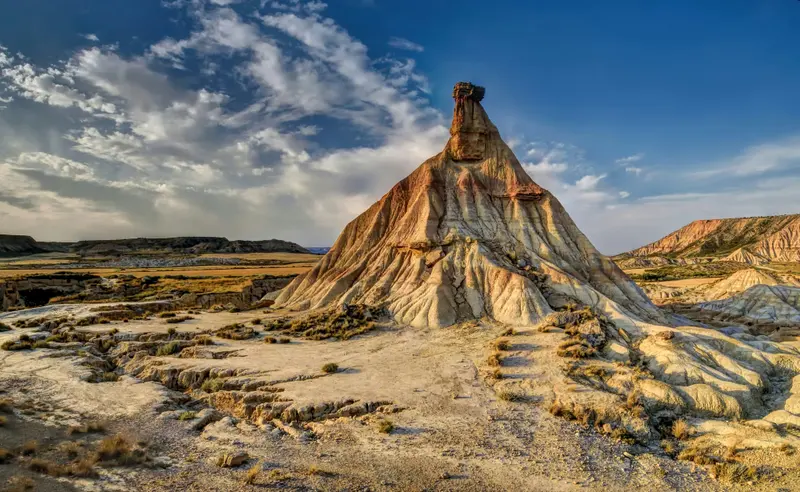
Bardenas Reales
Bardenas Reales is an area of dry plains, gullies and rock that wears into distinctive shapes. Castildetierra, in the area called Blanca Baja, is one of the formations you can single out. Use the visitor map and current notices from the managing authority to identify the routes you can use. Shade is scarce. Choose your stops and leave room to turn back if conditions change. It is worth seeing the terrain from more than one viewpoint, even if you only cover a short route.
Fitero and Tarazona
At Fitero, the Cistercian monastery gives you a different sense of the religious architecture of the Ribera. Check the visit arrangements and leave time to walk the streets beside the buildings. Tarazona, across the regional border in Aragón, works as a separate visit to an old town or as a destination on the greenway. If you plan to ride the entire route and continue the trip from there, decide in advance how to transport your luggage.
Where to stay in Tudela
The old town puts the cathedral and both main museums within walking distance. Around Plaza de los Fueros you can start and finish most walks at the square. With a car, find the parking first, then check the walk to the accommodation. A room near the square may make it easy to walk back from a festival event while taking a little longer to reach with bags.
If you are leaving early by train, consider staying between the station and the old town. You can spend the previous afternoon on the city walks and have less to carry in the morning. For the Bardenas, check where and when you will meet a transfer or collect a vehicle. Two nights in the same place can give you a full day on either side of that journey.
Find accommodation in Tudela (opens in a new tab)Affiliate link: if you book through it, we may earn a commission at no extra cost to you.